
Brown Jr., Eliphalet M.

Eliphalet M. Brown Jr. (1816 - January 24, 1886) was an American daguerreotypist, lithographer, and photographer. He was born in Newburyport, Massachusetts. By 1837, he was working as an artist and lithographer in New York. His name appears on the records of Currier and Ives, among other firms. In 1841 he exhibited at the National Academy of Design, New York. Brown arranged for his younger brother, James Sydney Brown to find a position in the innovative new field of daguerreotype photography. He apprenticed in a gallery owned by Matthew Brady. Both brothers were so impressed with photography that, in 1846, they jointly started a studio, The American Gallery. According to one reference, Eliphalet was an expert lithographer, while James focused on photography. Between 1848 and 1851, Eliphalet left the partnership with his brother and worked with Charles Severyn and, then Currier and Ives. Around this time, he was famously selected to accompany the 1852 - 1854 diplomatic mission to Japan led by Commodore Matthew C. Perry - it is a curiosity of history that Eliphalet, the lithographer, not his brother James, the photographer, was chosen by Perry (who knew them both) as the official expedition photographer. Along the way he took over 400 historical photographs recording the first significant contact between Americans and Tokugawa Japanese. Unfortunately, 6 of these images were lost to an April 11, 1856 fire at a Peter S. Duval Lithography Company in Philadelphia, but contrary to some irresponsible scholarship, most survived. Despite this fact, few are known in institutional and private collections, the remainder presumably consigned to a government archive and simply lost. Others were copied by the artist Wilhelm Heine, who painted them and in partnership with Brown, transferred them to lithographic prints. When Brown returned from Japan, he gave up photography for the Navy Life. He served as a Master and Ensign during the American Civil War. Later he was assigned to the Mediterranean. Brown retired from naval life in 1875, at which time he married and lived quietly until his death in 1886.
New York in the mid-19th century.
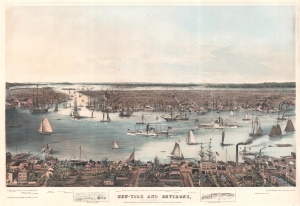
New-York and Environs, from Williamsburgh.
$8,000.00
Acquire
- Digital Map Information
- Suitable for large format printing
- DPI: 600
- File Size: 107.61 MB
- File Type: ZIP / TIFF
- ICC color profile embedded
- Delivered instantly via download link
This is an 1848 Edgar W. Foreman and Eliphalet M. Brown, Jr. bird's-eye view of New York City. Looking west over the East River and Manhattan from Williamsburg, ships navigating the East River, particularly several side-wheel steamers (one of which is named for Cornelius Vanderbilt) act as focal points. Manhattan's East River wharves, warehouses, and factories are also particularly well illustrated. Ships then pass between Manhattan and Brooklyn (with Brooklyn Heights and the Navy Yard well depicted) and into New York Harbor in the background. New Jersey and Staten Island appear along the horizon. (more details)
New York in the mid-19th century.
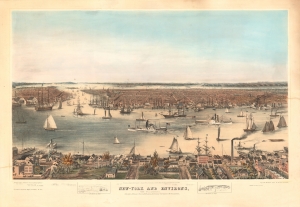
New-York and Environs, from Williamsburgh.
$5,500.00
Acquire
- Digital Map Information
- Suitable for large format printing
- File Size: 38.43 MB
- File Type: ZIP / TIFF
- ICC color profile embedded
- Delivered instantly via download link
This is an 1848 Edgar W. Foreman and Eliphalet M. Brown, Jr. bird's-eye view of New York City. The view looks west over the East River from Williamsburg towards lower Manhattan, offering a unique look at the Brooklyn waterfront life before the Civil War. (more details)