
Duane, James Chatham
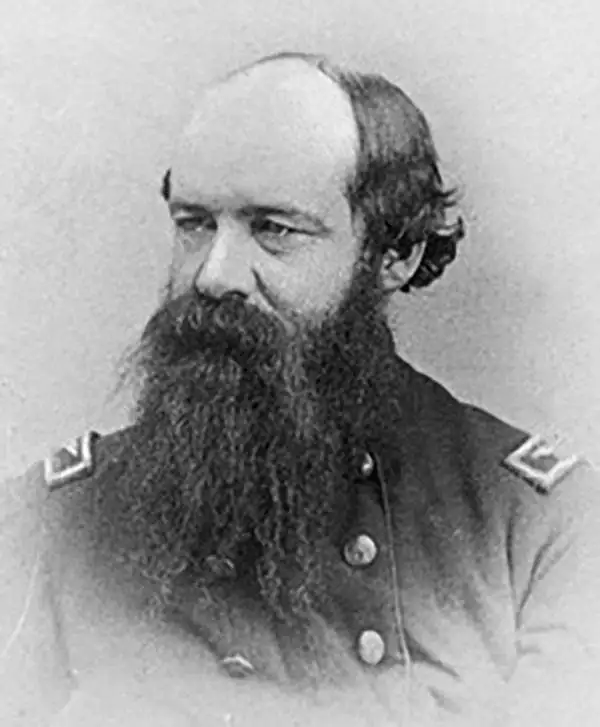
James Chatham Duane (June 10, 1824 - December 8, 1897) was an American engineer and U.S. Army officer. Born in Schenectady, New York, Duane graduated from Union College in 1884 and then attended the United States Military Academy at West Point and graduated third in his class in 1848. From 1852 through 1854, Duane taught practical military engineering at West Point. He commanded a select group of engineer troops that guarded President Abraham Lincoln at his 1861 inauguration. In 1862 at the Battle of Harpers Ferry Duane built the first military pontoon bridge of the Potomac River and served as Chief Engineer of the Army of the Potomac from 1863 until 1865. He commanded at Williets Point, New York, from 1866 through 1868 and constructed fortifications along the Maine and New Hampshire coasts from 1868 until 1878. He served as president of the Board of Engineers from 1884 through 1886. On October 11, 1886, he was appointed brigadier general and Chief of Engineers and retired on June 30, 1888. After retiring he became Commissioner of the Croton Aqueduct in New York City. In 1850 he married Harriet Whitehorne Brewerton (1839 - 1914) with whom he had three children. He died in New York City.
Immediately prior to Cold Harbor.
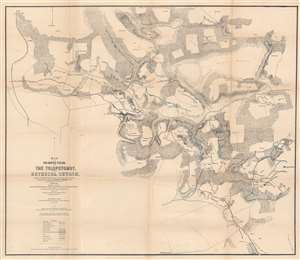
Map of the Battlefields of The Tolopotomoy and Bethesda Church Showing the Field of Operations of the Army of the Potomac Commanded by Maj. Gen. George G. Meade U.S. Army From May 28th to June 2nd 1864.
$750.00
Acquire
- Digital Map Information
- Suitable for large format printing
- File Size: 32.4 MB
- File Type: ZIP / TIFF
- ICC color profile embedded
- Delivered instantly via download link
This is an 1864 Charles W. Howell and James C. Duane map of the battle of Totopotomoy Creek, fought during the American Civil War (1861 - 1865). Depicting the battlefield and the immediate surroundings, red highlights Confederate lines while blue emphasizes Union positions. Red and blue lines illustrate Confederate positions captured by the Union. Army of the Potomac headquarters throughout the battle are labeled and marked with a small American flag. Homesteads in the region, the local store, and churches are identified by name. (more details)