
Coffyn, Lucien Florent Paul (Paul Coffyn)
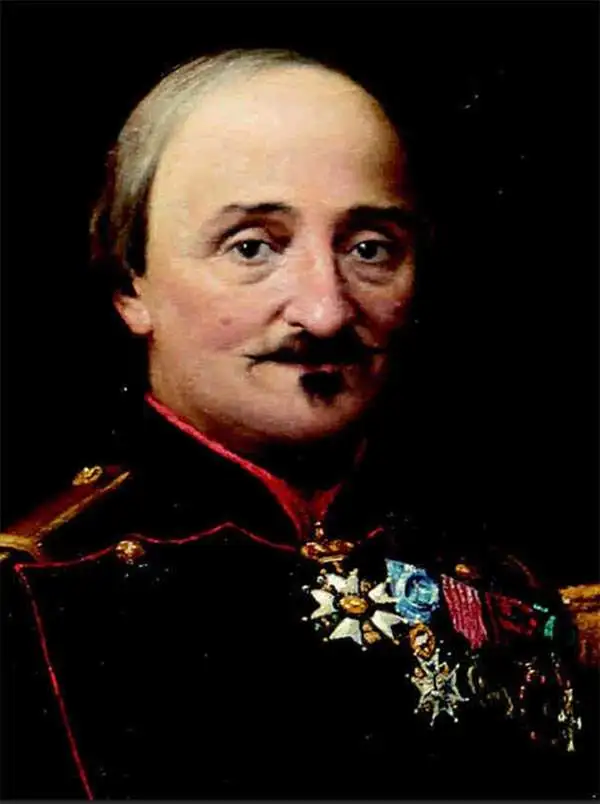
Lucien Florent Paul Coffyn (Paul Coffyn; May 20, 1810 - August 5, 1871) was a French military engineer, urban planner, and cartographer active in France's overseas possessions: Algeria, Tahiti, the Marquesas, Nouvelle-Calédonie, China, Saigon, etc. Coffyn was born in Dunkirk, the son of François Joseph Coffyn, a prominent merchant and the U.S. Consul for Pas-de-Calais. He studied military engineering, joining the Marines Corps du Génie. His first service was in Montpellier, followed by Valenciennes and Algeria. He was sent to the Pacific in 1849 to become Chief Engineer of Tahiti and the Marquesas, where he laid out the colonial capital Papeete (Plan terrier du Domaine de l'Etat. Croquis Annexe au Memoire Annuel, 1849; National Library of New Zealand). For this and other work, he was given the Légion d'Honneur in 1856. Afterward, he was sent briefly to Nouvelle-Calédonie. When the Second Italian War of Independence (1589) broke out, he was briefly reassigned to Italy. In 1861, in the wake of the Second Opium War (1856 - 1860), Coffyn was commissioned as the Chief of the French Engineers in China. Later that year, he was made the 'Colonel Commandant le Génie en Cochinchine'. Following his success in this post, he retired, somewhat, taking a position as Director of Engineers at Brest.
AKA: Paul Coffyn
Foundational manuscript plan of colonial Saigon.
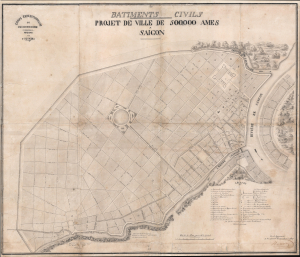
Batiments Civils Projet de Ville de 500,000 Ames Saîgon.
$35,000.00
Acquire
- Digital Map Information
- Suitable for large format printing
- File Size: 36.53 MB
- File Type: ZIP / TIFF
- ICC color profile embedded
- Delivered instantly via download link
This is Lucien Florent Paul Coffyn's 1862 manuscript masterplan of Saigon - the first and most significant map of Saigon (Ho Chi Minh City). Coffyn was the French military engineer tasked with transforming a war-torn fort into a model colonial capital. Following the 1861 French occupation of Saigon, authorities resolved to build a new city on the wartorn site at a monumental scale, reflecting boundless imperial ambition. Coffyn, driven by an unwavering belief in the colony's promise, envisioned a grand, European-style metropolis designed to accommodate half a million residents across 25 square kilometers. The present map - exquisitely drafted and signed by both Coffyn and Vice Admiral Louis Bonard, Governor of Cochinchina - is the likely original manuscript submitted for formal approval. Over the subseqeunt decades, Coffyn's street layout and placement of major sites were implemented with fidelity, though not comprehensively, marking this as the foundational document of colonial Saigon. It stands as a unique testament to French imperial planning and an unparalleled artifact of Asian colonial urbanism. (more details)