
Devambez, Édouard
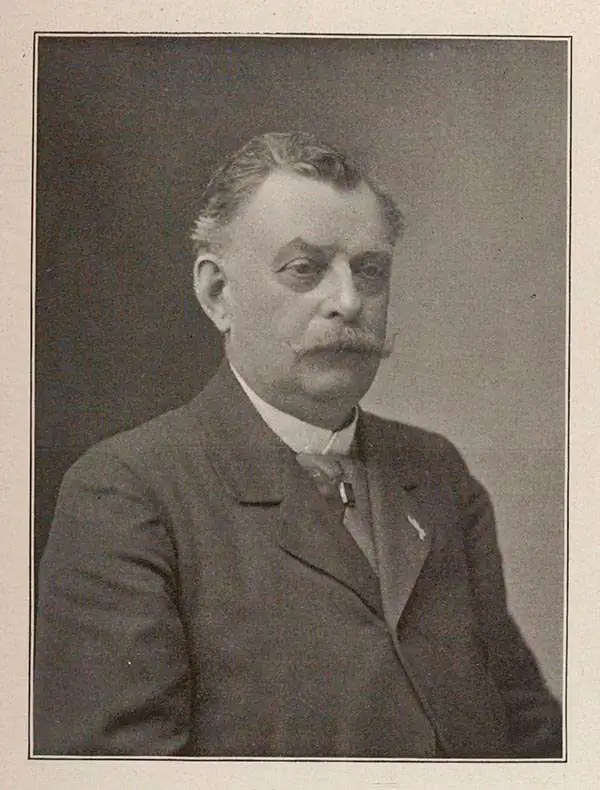
Édouard Devambez (March 11, 1844 - June 2, 1923) was a French illustrator, painter, and engraver active in Paris in the late 19th and early 20th centuries. He began printing commercially 1870. In 1873 he acquired the business of Hippolyte Brasseau, renaming it Maison Devambez. At first the firm specialized in heraldic images, letterheads, and invitations for such names as the House of Orléans, the House of Bonaparte, and the Élysée Palace. Devambez widened the scope of the business to include advertising and publicity, artists’ prints, luxurious limited-edition books, and an important art gallery. The House became recognized as one of the foremost fine engravers in Paris, winning numerous medals and honours In 1877 he was elected a member of the Académie des Beaux-Arts. In 1900, at the Exposition Universelle de Paris, he was named a Chevalier de la Légion d’Honneur and obtained the prestigious title Notable Commerçant. After his death and burial at Père Lachaise, the business was taken over by his son, Andre Victor Edouard Devambez (1867 - 1943), himself a famous painter. The firm still operates to this day.
The Spirit of America turns the tides of WWI.
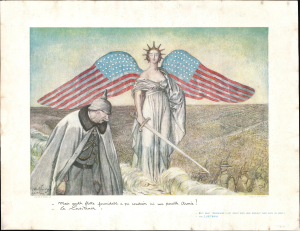
Mais quelle flotte formidable a pu conduire ici une pareille armée? - Le Lusitania. / [But! What tremendous fleet could ever have brought over such an army? - the LUSITANIA.]
$3,500.00
Acquire
- Digital Map Information
- Suitable for large format printing
- Full resolution TIFF file
- ICC color profile embedded
- Delivered instantly via download link
A striking 1918 Jules Abel Faivre French broadside celebrating the United States' entry into World War I (1914 - 1918). The broadside was issued shortly after the American Expeditionary Force landed some 1.2 million soldiers in Europe, marking a turning point toward inevitable Allied victory. The image is centered on Winged Liberty representing the 'Spirit of America'. Her wings take the form of American Flags, and she carries a sword in her right hand, ready to defend liberty. Her eyes are frozen white and distant, underscoring both detachment and purity. Behind her march endless troops of the American Expeditionary Forces (AEF). In the foreground, the German Kaiser, Wilhelm II (1859 - 1941), looks on despondently, aware of his impending and inevitable defeat. (more details)