
Loureiro, Adolfo Ferreira
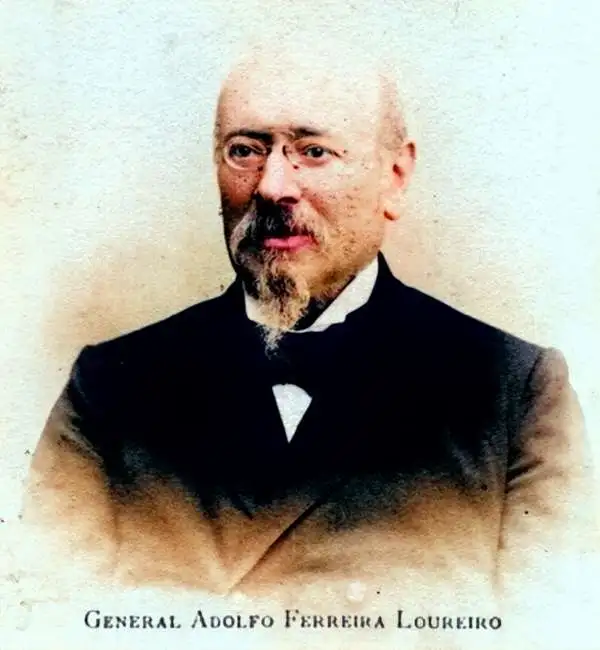
Adolfo Ferreira Loureiro (December 12, 1836 - November 22, 1911) was a Portuguese soldier, engineer, writer, poet, and politician. Loureiro was born in São Bartolomeu, Coimbra, Portugal. He studied mathematics and civil engineering at the University of Coimbra and entered the military in 1858. In 1883, he traveled to British India, Ceylon, Singapore, China, and Macau. In Macao, he accepted a commission as Captain of Engineering and Major of the General Staff, working on desilting the port of Macao. At the same time, he became involved in politics and was elected in 1890 as 'Deputado' to the 1.° Círculo Eleitoral de Macau. A prolific writer, he penned more than 24 works, but is best known for his travel narrative, De Nápoles à China (diário de viagem) (Lisboa: Imprensa Nacional, 1896). Loureiro returned to Portugal where he had a distinguished engineering and academic career. He even curated and built an extensive historical collection of arms and armaments, which were donated to a museum. He was vice-president of the Lisbon Geographic Society, and was also president of the Geodesy section. He was president of the Almeida Garrett Literary Society. Member of the Academia de Ciencias de Portugal.
Pearl River Watershed.
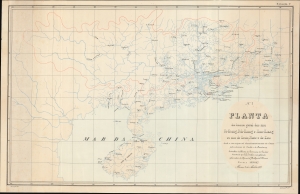
Planta da bacia geral dos rios Si-Kiang, Peh-Kiang e Han-Kiang ou rios do Oeste, Norte e de Este, desde a sua origem até desenbocarem no mar da China pelos estuários de Cantão e do Broadway.
$1,200.00
Acquire
- Digital Map Information
- Suitable for large format printing
- File Size: 488.68 MB
- File Type: ZIP / TIFF
- ICC color profile embedded
- Delivered instantly via download link
This is a remarkable 1884 Portuguese-language Adolfo Ferreira Loureiro map of Guangdong Province (广东; Canton), China, including Hong Kong, Macao, Guangzhou, and the Pearl River Estuary. The map was designed by Loureiro to assist in his engineering commission to control silt build-up in Macao Harbor. It thus focuses on the vast watershed that drains into the Pearl River, and is, as such, among the earliest works to address the complex river system. (more details)