
Mingjie Liu (刘明杰, Liu Mingjie)

Mingjie Liu (1857 - 1911) (刘明杰) was a Qing Dynasty Chinese folk artist and printer. He was born in Xiyangjiabu Village, Hanting District, Weifang, Shandong, China. He is known for his paintings and folk characterizations, mubǎn nianhua (木版年画), made for Chinese New Year Festivals - a Shandong tradition - which he began producing at just 8. Politically, he was nationalist but anti-imperialist and anti-feudalist. He created many paintings and prints satirizing the ruling elite - including the Dowager Empress Cixi - and deploring foreign incursions into China. Most of his work was eventually seized and destroyed as subversive. His cartographic corpus is limited, but he is known for three maps, among them his Full Modern and Ancient Map (古今地舆全圖), which was issued as early as 1892 and is China's first commercially produced map. In 1811, Mingjie Liu traveled to the city of Yingkou, Liaoning province, in order to sell a painted fan. On the way he established himself in an abandoned temple. During a torrential rainstorm, the decrepit building collapsed, killing Liu.
AKA: 刘明杰, Liu Mingjie
The first Chinese designed and issued commercial map.
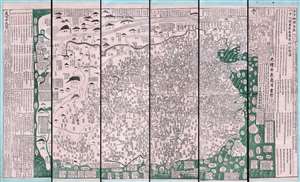
古今地舆全圖 / Full Modern and Ancient Map.
$65,000.00
Acquire
- Digital Map Information
- Suitable for large format printing
- Full resolution TIFF file
- ICC color profile embedded
- Delivered instantly via download link
A rare and important discovery, this is Mingjie Liu's (刘明杰) (1857 - 1911) important 1892 (Guangxu 18) Qing Era xylographic (woodcut) map of China - the earliest known example of what is considered China's first commercial map and possibly the first Chinese comical map. The map was revolutionary when Liu created it, as this was neither administrative nor religious; instead, it was a commercially marketed folk piece, muban nianhua (木版年画), created in Yangjiabu, Shandong, for traditional Chinese New Year festivals. Coverage extends to all of China, as well as marginal inclusions in the form of tenuous mappings of foreign places, including European countries, Southeast Asia, India, and apocryphal destinations. (more details)