
Woodward, William Henry
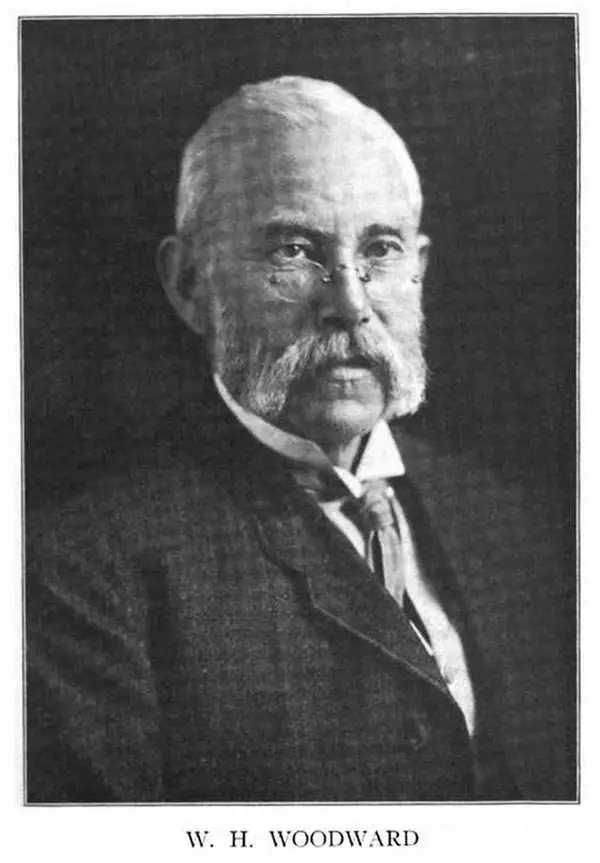
William Henry Woodward (December 11, 1834 - November 30, 1904) was an English-American printer and publisher based in St. Louis. Woodward was born in Hereford, England. He moved with his parents to the United States in 1841-2, when his father had a disagreement with the Church of England, and they moved to New Jersey, where he was ordained an Episcopal Minister. The family moved between churches in Pennsylvania, Michigan, and Wisconsin (1849 - 1851) before finally, in 1851-2, settling permanently in St. Louis. William Henry remained in Madison, where from 1849 to 1852, he apprenticed in the printing trade under Col. David Atwood, publisher of the Wisconsin Statesman. In St. Louis, he began his career in the printing trade at the Missouri Republican, then the main regional paper. He attained some success and leveraged his savings to purchase the printing concern of George H. Hanson. Woodward's establishment quickly gained a reputation for solid work promptly delivered. During the U.S. Civil War, Woodward was recruited into the Missouri Home Guard and saw active service under General. E.C. Pike, including during the invasion of Missouri by Confederate General Sterling Price in 1864. In 1868, James Tiernan (1838 - September 16, 1886), a former colleague from the Missouri Republican, joined the firm, after which the imprint changed to 'Woodward and Tiernan.' The business also moved to the intersection of Third and Pine. In 1872, William B. Hale joined the partnership, and the imprint was changed again, this time to 'Woodward, Tiernan and Hale.' The business moved again, this time to the intersection of Second and Locust. Hale retired in 1882, causing the firm's imprint to revert to 'Woodward and Tiernan.' Tiernan passed away in 1886, just as the firm was preparing to move into even larger quarters at 309-315 North Third Street. Woodward acquired Tiernan's shares and reorganized the firm as the 'Woodward and Tiernan Stock Company.' By 1900, the company operated as the 'Woodward and Tiernan Printing Company'. Under Woodward's management, the company grew into a major concern, employing around 800 people and operating several factories. Woodward died of a heart attack at the St. Louis Club in November 1904. The firm operated until 1966, and in its later years was known as the Woodward Printing Company. William Henry Woodward married Miss Maria K. Knight in December 1859, and the couple had thirteen children, five of whom died in infancy. Their eldest daughter preceded them in death as well. She died on August 20, 1889. Maria Woodward died on June 16, 1898. Woodward remarried on February 8, 1899, to Miss Laura Maria Bingham.
Stunning railroad broadside promoting emigration to Texas.
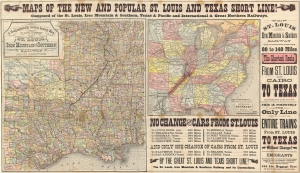
Maps of the New and Popular St. Louis and Texas Short Line!
$900.00
Acquire
- Digital Map Information
- Suitable for large format printing
- File Size: 54.88 MB
- File Type: ZIP / TIFF
- ICC color profile embedded
- Delivered instantly via download link
A striking 1878 promotional map broadsheet issued to promote travel on the St. Louis and Texas Short Line. (more details)
One of the few railroads that received a federal charter.
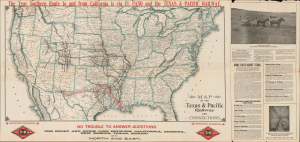
Map of the Texas and Pacific Railway and Connections. / The Texas and Pacific Railway The Short Line from Texas, Mexico and California to St. Louis, Memphis and All Points North and East. / The Texas and Pacific Railway The Direct Through Line from California, Colorado, and the West to Shreveport, New Orleans, Memphis and All Points in the Southeast.
$850.00
Acquire
- Digital Map Information
- Suitable for large format printing
- DPI: 600
- File Size: 72.4 MB
- File Type: ZIP / TIFF
- ICC color profile embedded
- Delivered instantly via download link
This is a 1911 Woodward and Tiernan railroad map of the United States illustrate the routes of the Texas and Pacific Railway, one of the few railroads established by federal charter. The Texas and Pacific Railway was a Congressional attempt at reviving a southern transcontinental railroad, only two years after the first transcontinental railroad was finished. The route of the Texas and Pacific is immediately identifiable in red, and the extensive U.S. railroad network is also illustrated. (more details)