
Frisius, Gemma (Reinerszoon, Jemme)

Gemma Frisius (December 9, 1508 - May 25, 1555) born Jemme Reinerszoon, was a Dutch scholar, mathematician, cartographer, physician, and instrument maker. He is one of the first Dutch mapmakers, whose work would set the groundwork for the preeminence of Dutch cartography in the 16th and 17th centuries. His parents were poor, but he would nevertheless be able to study at the University of Leuven, achieving his MD in 1536. He would teach there his whole life, in the fields of medicine, mathematics, astronomy, and geography. Among his students was the illustrious Gerard Mercator. Gemma was prolific, editing many editions of Apianus' foundational Cosmographia, but also producing globes, mathematical instruments, and surveying tools. In 1533, he first described in print the method of surveying by triangulation. He was the first to describe how a clock might be used to determine longitude (he considered this a theoretical puzzle, believing that man could not produce a sufficiently accurate clock - a feat that would eventually be achieved by John Harrison in 1761). He died in 1555 from kidney stones.
AKA: Reinerszoon, Jemme
The best introduction to Cosmography, in a complete, original example.
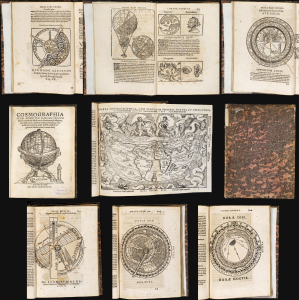
Cosmographia Petri Apiani, Per Gemmam Frisium apud Louanienses Medicum et Mathematicū insignem, iam demum ab omnibus vindicata mendis, ac nonnullis quoque locis aucta. Additis eiusdem argumenti libellis ipsius Gemmae Frisij.
$11,000.00
Acquire
- Digital Map Information
- Suitable for large format printing
- Full resolution TIFF file
- ICC color profile embedded
- Delivered instantly via download link
This is Gemma Frisius' 1564 edition of Peter Apian's Cosmographia, which from 1524 was the essential scholarly introduction to the world and its place in the cosmos. This concise text touched on astronomy, geography, cartography, and navigation. It was not a rote copy of Apianus' text, with significant commentary from Gemma, as well as that scholar's own world map. The text includes its five volvelles, all assembled and in their original condition. These manipulable diagrams are often found missing parts or replaced in facsimile; the condition of these here represents a remarkable survival. (more details)