
Lugard, Frederick John Dealtry
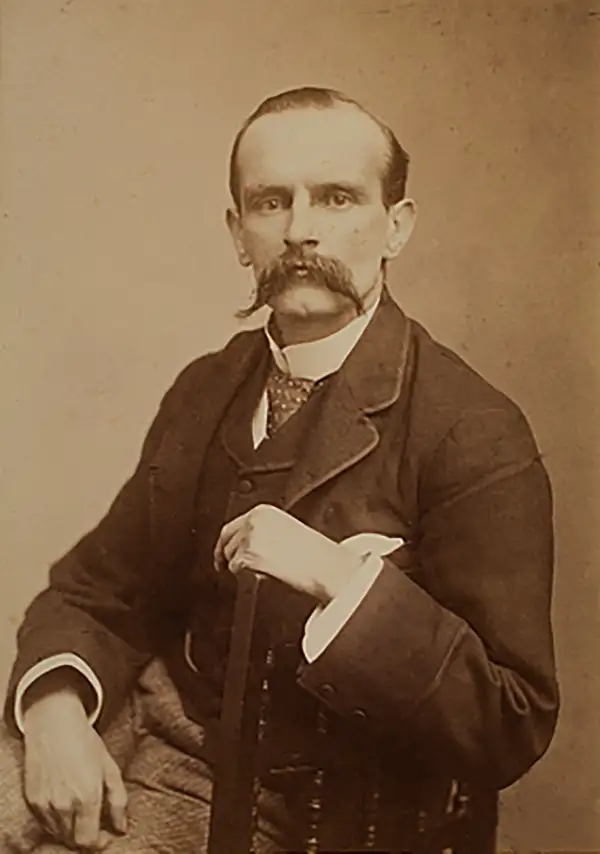
Frederick John Dealtry Lugard (January 22, 1858 - April 11, 1945) was a highly-decorated British soldier, explorer, and colonial administrator active in East Africa, Hong Kong, and Nigeria over the course of his career. In brief, he was one of the most consequential British colonial figures in the history of British colonialism in Africa. Lugard was born in Madras to a British Army chaplain, while his father's brother was Sir Edward Lugard, Adjutant-General in India from 1857 to 1858 and Permanent Under-Secretary of State for War at the War Office from 1861 to 1871. The younger Lugard was educated in England, eventually graduating from the Royal Military College at Sandhurst. He then returned to India and served with distinction in the Royal Norfolk Regiment during the Second Anglo-Afghan War (1878 - 1880), the Sudan campaign (1884 - 1885), and the Third Anglo-Burmese War (1885). Following an embarrassingly unsuccessful pursuit of a love interest, Lugard relocated to East Africa to relaunch his career. He fought in the Karonga War around Lake Malawi on behalf of the African Lakes Company, but was unable to dislodge a group of Swahili traders who had fallen out with the British from their stockade. Lugard then joined the Imperial British East Africa Company (IBEAC), where he was tasked with scouting a route from Mombasa to Machakos in order to formalize a British 'sphere of influence' (contra growing German influence) claimed between Uganda and Zanzibar. Along the way, Lugard sketched out a scheme for emancipating slaves in the area, built fortifications to allow for future IBEAC travels along the same route, and established alliances with local chiefs by swearing blood oaths with them. He served as Military Administrator of Uganda from December 1890 to May 1892, where he further explored and mapped much of the country. When he returned to Britain afterwards, Lugard successfully lobbied Prime Minister William Gladstone from allowing the IBEAC to abandon Uganda. During this time, he also published the book The Rise of Our East African Empire. In 1894, Lugard was sent by the Royal Niger Company to Borgu, on the border of today's northwest Nigeria and Benin, to establish British influence, as the French were also encroaching in the area. Aside from a brief period when he was leading an expedition to Lake Ngami in modern-day Botswana, Lugard spent the next 12 years in Nigeria. From 1897 to 1899, he organized and commanded the West African Frontier Force that would engage in any conflict with the French, but the borders were ultimately arranged through negotiation. Lugard then was appointed High Commissioner of the newly created Protectorate of Northern Nigeria. There, he oversaw campaigns against the recalcitrant Sokoto Caliphate and their vassals, mapped and surveyed the territory, stopped slave trading and abolished slavery locally where possible, reorganized taxations, and regularized a system of indirect rule through local elites. In short, Lugard greatly expanded British influence in northern Nigeria by the time he left his post as High Commissioner in 1906, and he was knighted for his efforts in 1901. From July 1907 to March 1912, Lugard served as the Governor of Hong Kong, where he prioritized education, helping establish the University of Hong Kong. In September 1912, Lugard returned to Nigeria to serve as governor of both the Northern and Southern Nigeria Protectorates, in preparation for their merger in 1914, after which he was the governor of a unified Nigeria until August 1919. His tenue was defined by the effort to amalgamate Northern and Southern Nigeria, introducing uniform communications, taxes, customs, time standards, courts, currency, and civil service. Though well-intentioned, this effort failed in the long term and may have even unintentionally exacerbated regional differences, laying the groundwork for ethnic conflict in subsequent decades. His tenure also saw renewed border tensions with the French and the violent suppression of a tax revolt. Lugard's attitude was typically paternalistic, seeing the role of the British to spread civilization, including Christianity, abolish slavery, and lay the groundwork for some distant era of self-administration. After leaving his governorship, Lugard wrote a book on British colonial administration in Africa (The Dual Mandate in British Tropical Africa) and served from 1922 until 1936 as the British representative on the League of Nations' Permanent Mandates Commission. He also served on several other League of Nations commissions, including those tasked with suppressing slavery internationally, resulting in the 1926 Slavery Convention. Lugard was highly decorated throughout his career and was eventually, in 1928, elevated to a Baron. He also received a Founder's Medal from the Royal Geographical Society in 1902 for his explorations in Africa. In 1902, Lugard married Flora Shaw (1852 - 1929), a writer and journalist who is credited with coining the term Nigeria that became the name of the British territory and later independent country. The couple had no children and Lugard's barony became extinct upon his death. Between 1959 and 1963, a four-volume work, The Diaries of Lord Lugard, was published in Britain just as Nigeria was gaining its independence.
The Foundation for British Rule in East Africa.
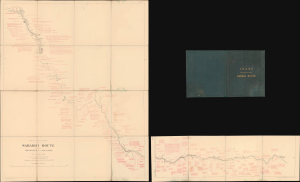
Rough Road Chart of Sabakhi Route from Makangeni to Machagos.
$2,500.00
Acquire
- Digital Map Information
- Suitable for large format printing
- Full resolution TIFF file
- ICC color profile embedded
- Delivered instantly via download link
This rare 1890 map of Kenya illustrates Frederick Lugard's first expedition along the Sabaki River between Mombasa and Machakos. The expedition and Lugard's subsequent public pressure campaign were important steps in establishing a British 'sphere of influence' and, eventually, protectorates over Kenya (British East Africa) and Uganda. (more details)