
Wadström, Carl Bernhard (C. B. Wadstrom)
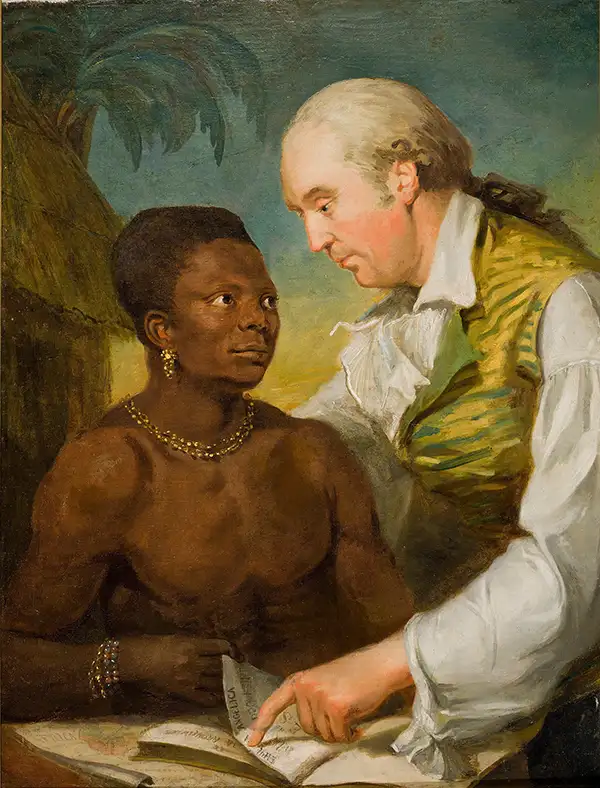
Carl Bernhard Wadström (C. B. Wadstrom; April 19, 1746 - April 6, 1799) was a Swedish engineer, industrialist, economist, artist, cartographer, religious visionary, and one of the most influential continental participants in the British and French abolitionist movements. Born in Stockholm and trained in mining and surveying at Uppsala, he entered the Swedish Board of Mines, worked under the metallurgist Sven Rinman, and pursued an energetic career in engineering, manufacturing, and industrial reform. His abolitionism arose partly from the mystical theology of Emanuel Swedenborg, who taught that Africans possessed a distinctive capacity for inward spiritual enlightenment and preserved an uncorrupted apprehension of divine truth. Inspired by these ideas, Wadström established a society at Norrköping in 1779 devoted to replacing the slave trade with agricultural commerce and, in 1786, co-founded the Exegetical and Philanthropic Society, which sought to translate Swedenborgian principles into social reform. In 1787, King Gustav III placed Wadström at the head of an expedition to Guinea intended to identify a location for a Swedish commercial and philanthropic settlement; accompanied by Anders Sparrman and Carl Axel Arrhenius, he traveled through Senegal and Gorée, where his firsthand observation of the slave trade hardened his opposition to it. Settling in England in 1788, Wadström joined Thomas Clarkson, Granville Sharp, and William Wilberforce, supplied evidence used in parliamentary debates, and testified before the Privy Council and House of Commons between 1789 and 1791. He was baptized into London's Swedenborgian New Jerusalem Church on Christmas Day 1788 and joined other Swedenborgians in endorsing A Plan for a Free Community upon the Coast of Africa (1789), a proposed constitution - probably written principally by August Nordenskjöld - for an experimental Sierra Leone settlement protected by Britain but independent of European law and government. Envisioned as a self-governing society without masters or slaves, the colony was to unite religious regeneration, free labor, agriculture, education, and equitable commerce. However, its program remained shaped by the paternalism and colonial assumptions of its age. Wadström publicized the brutality he had witnessed in Observations on the Slave Trade (1789), influential engravings of slave ships, and his major two-volume Essay on Colonization, Particularly Applied to the Western Coast of Africa (1794-95), which combined maps, illustrations, moral argument, and political economy to contend that Africans were more valuable as free producers and trading partners than as enslaved laborers. After moving to Paris in 1795, he urged revolutionary France to cooperate with Britain in abolishing slavery, became a leading member of Les Amis des Noirs et des Colonies, received honorary French citizenship, and convened an international conference on colonial reform shortly before his death at Versailles in 1799, after which he was honored with a French state funeral.
AKA: C. B. Wadstrom
We're Still Hunting
We don't yet have any maps by this cartographer in stock — but that's more a matter of timing than availability. New acquisitions arrive regularly, and pieces from this maker do surface. Check back soon, or reach out if you're specifically looking for one — we're always happy to keep an eye out.
Have a map by this cartographer you're looking to sell? We'd love to hear from you.