
1909 Hegeman Map Game of New York City and Hudson Valley, Early Aviation

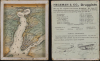

[Flight Game: New York City and Hudson River Valley].
Getting Off the Ground.
$1,200.00
Choose a Collection:
This Item
Enquire
Getting Off the Ground.
This is the sole surviving example of a c. 1909 chromolithograph promotional view of New York City and the Hudson Valley issued by the druggists Hegeman and Co. A remarkable piece in several respects, it is perhaps most notable for reflecting the popular enthusiasm around the early days of aviation in the United States.A Closer Look
The view looks northwards from New York Harbor, with New York City in the foreground, the Hudson Valley at center, and Albany, the game's destination, in the background. It sits within a box with a glass front and features two tokens, one representing the Santos-Dumont Dirigible (1901) and another the Wright Brothers' Airplane (1908). The challenge is to, by jostling the game, move the tokens to the squares at the top of the map. Presumably, the game was meant to be passed back and forth between players, each of whom is assigned an aircraft. This was an imagined race rather than a real one, but both aircraft were well-known in their day, though the Wright Brothers have become much more famous to posterity.Getting Off the Ground
The early history of aviation was shaped by decades of experimentation with lighter-than-air flight before the development of true airplanes. In the late 18th century, the Montgolfier brothers in France launched the first successful hot air balloon, sparking a wave of fascination with human flight. By the late 19th century, inventors turned to airships, or dirigibles, which combined lighter-than-air lift with engines and methods of steering. Pioneers like Count Ferdinand von Zeppelin developed rigid-framed airships that could carry passengers and cargo, demonstrating that controlled and sustained flight was possible. These airships played a crucial role in establishing aviation as a practical field, even if their reliance on large envelopes of gas and relatively slow speeds limited their long-term potential.Another pioneer in the field of dirigibles, much less known than Zeppelin outside of his home country of Brazil, was Alberto Santos-Dumont (1873 - 1932). An inveterate tinkerer who loved all manner of machines and the works of Jules Verne, and helpfully inherited a vast fortune on account of his family's coffee plantations, Santos-Dumont was the archetypal late-19th century adventurer-inventor. After becoming an enthusiastic mountaineer, Santos-Dumont began building his own balloons, at first hot-air balloons and then proper airships. Unlike Zeppelin's rigid-framed airships, Santos-Dumont's ships filled a flexible envelope with gas, more akin to a hot air balloon.
Despite nearly dying while flying the first model of his airship in 1898, Santos-Dumont continued to improve the design until in October 1901 he scored a public relations coup when he won the Deutsch de la Meurthe Prize, which offered a substantial reward to the first aviator who could fly from the Parc Saint-Cloud to the Eiffel Tower and back (a distance of about 11 kilometers) in under 30 minutes. Santos-Dumont became an international celebrity, considered the world's only aviator capable of extended controlled flight. However, he also began to realize the limitations of dirigibles and, in the following years, turned his attention towards heavier-than-air designs, i.e., airplanes. He produced a series of planes of his own design and scored several aviation firsts, but is not as well remembered as some other aviation pioneers, such as the Wright Brothers.
Orville and Wilbur Wright's Flyer, built in Dayton, Ohio, and flown at Kitty Hawk, North Carolina, marked the first powered, sustained, and controlled airplane flight. Their success was not just in building an engine light enough to fly, but also in developing a system of three-axis control that allowed the pilot to steer effectively. This innovation distinguished their work from earlier attempts and laid the foundation for all modern aircraft design. Knowing the true value of their invention was in its steering mechanisms, the Wright Brothers were intensely secretive about their designs and fought legal battles for years with fellow aviation pioneers, especially Glenn Curtiss, over the patent to their steering system. Unlike the image of the dashing and romantic aviator à la Santos-Dumont, the Wright Brothers were austere, reserved, and sententious (their father Milton was an evangelical Christian clergyman who led his own conservative schismatic offshoot of the Church of the United Brethren in Christ).
Although they eventually won their patent war with Curtiss and others, the struggle exhausted the brothers and arguably distracted them from developing further innovations, falling behind competitors. But there can be no doubt that the brothers won the battle for historical memory, being known to posterity as the inventors of the airplane. They also bested airship competitors like Santos-Dumont and Zeppelin. While airships continued to be used well into the early 20th century, the Wright Flyer signaled a new era where airplanes would soon eclipse lighter-than-air craft in speed, range, and versatility, setting aviation on the path to becoming one of the defining technologies of the modern age.
Chromolithography
Chromolithography, sometimes called oleography, is a color lithographic technique developed in the mid-19th century. The process involved using multiple lithographic stones, one for each color, to yield a rich composite effect. Oftentimes, the process would start with a black basecoat upon which subsequent colors were layered. Some chromolithographs used 30 or more separate lithographic stones to achieve the desired product. Chromolithograph color could also be effectively blended for even more dramatic results. The process became extremely popular in the late 19th and early 20th centuries when it emerged as the dominant method of color printing. The vivid color chromolithography produced made it exceptionally effective for advertising and propaganda imagery.Publication History and Census
This view game was prepared by the druggist (pharmacist) company Hegeman and Co., which had nearly 20 locations in the New York City area (in 1910, the company merged with a competitor and became known as the Riker-Hegeman Company). The game is signed 'W. C. Davids, Jr.' at bottom; it would be impossible to know for certain, but this may be the son of the W. C. Davids who was a well-known mechanical engineer in the New York City area in the early 20th century, and who filed several patents for engine designs. In any event, this is an extremely rare item and represents the only known example of this work.Condition
Very good. Some edge wear.
References
Rose, A., Empires of the Sky: Zeppelins, Airplanes, and Two Men's Epic Duel to Rule the World, (New York: Penguin Random House) 2021. Goldstone, L., Birdmen: The Wright Brothers, Glenn Curtiss, and the Battle to Control the Skies, (New York: Random House) 2014.