
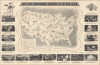
1946 Cluett, Peabody Pictorial Cotton Map of the United States of America


This item has been sold.
See How Important Cotton Is to the U.S.A.
The Last Days of 'King Cotton'.
Choose a Collection:
- Digital Map Information
- Suitable for large format printing
- File Size: 60.12 MB
- File Type: ZIP / TIFF
- ICC color profile embedded
- Delivered instantly via download link
This Item
Enquire
The Last Days of 'King Cotton'.
This is a rare c. 1946 pictorial map of the United States highlighting cotton and textile production, issued by the clothing manufacturer Cluett, Peabody, and Company. It reflects the state of the industry in the immediate postwar period, when firms like Cluett, Peabody, and Company were heavily investing in technological innovation and mechanization.A Closer Look
The map depicts the continental U.S. with representative illustrations for the country's various states and regions, such as corn in the Midwest, oil in Texas, and, of course, cotton in the Deep South. A text box at the lower-left provides statistics on the cotton industry, while photographs and text surrounding the map demonstrate different steps in the production process, from raw cotton bolls to completed shirts and other garments.Cluett, Peabody, and Company and the Evolution of the U.S. Cotton Industry
Although it no longer exists, Cluett, Peabody, and Company was a giant of the textile and clothing industry in the early-mid 20th century. Founded in 1851 as Maullin and Blanchard, the company underwent several leadership changes before George B. Cluett and Frederick Peabody joined forces, and it eventually incorporated under the name seen here in 1901. They initially specialized in detachable collars, a necessity for the 19th-century gentleman, but the firm truly revolutionized the market in the early 20th century with the introduction of the Arrow brand. Through the iconic 'Arrow Collar Man' advertising campaign, the company sold not just shirts, but an image of refined masculinity that defined the aesthetic of the era.By the late 1940s, the firm operated as a global powerhouse from its base in Troy, New York, and perhaps its greatest legacy was its contribution to textile science through the Sanforization process. Developed by Sanford Cluett (nephew of George Cluett) in the late 1920s and perfected throughout the 1930s and 1940s, this mechanical shrinking process became the global gold standard for cotton fabrics. Before Sanforizing, cotton garments were notorious for shrinking unpredictably in the wash; Cluett, Peabody, and Company solved this by mechanically compressing the fibers before the garment was ever sold.
Like the rest of the textile and clothing industry, the company was deeply impacted by the demands of World War II, pivoting from civilian production to supporting the Allied war effort. Cotton was considered a critical 'war crop,' essential for uniforms, tents, parachutes, and bandages. Technological advancements, such as the increasing adoption of mechanical cotton pickers, accelerated during this decade to compensate for the labor vacuum left by the war, fundamentally altering the economic landscape of the American South. By the late 1940s, the industry began to shift toward a more modernized, corporate structure as the wartime boom transitioned into the post-war consumer era. While the 1940s represented a period of high production and prosperity for firms like Cluett, Peabody, and Company, it also planted the seeds for future challenges. This era marks the final decade in which 'King Cotton' reigned supreme, before global competition and innovations in synthetic fibers began reshaping the market.
Publication History and Census
This map was published by the Education Service Department of Cluett, Peabody, and Company. No artist is identified, and the map is undated, although it refers to figures from 1946, so it was likely issued that year or soon afterwards. Only two examples are cataloged in the OCLC: one at Indiana University and the other at the Université Laval.Condition
Average to Good. Wear with small areas of loss along original fold lines.
References
OCLC 1246541333.