
1940-44 Winchell / Kamp Archive / Map on American Facism, Kamp-Winchel Feud

This item has been sold.
The Fifth Column Conspiracy in America. Authentic Map and DIrectory. / Archive of Kamp's Phamplets and Correspondence with Walter Winchell. / The Hour. / [Letters and Documents], Etc.
Unique archive of the vitriolic public dispute between celebrity journalist Walter Winchell and conspiracy theory fascist Joseph Kamp.
Unique archive of the vitriolic public dispute between celebrity journalist Walter Winchell and conspiracy theory fascist Joseph Kamp.
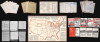
This is a c. 1940 - 1944 archive chronicling the vitriolic feud between the conspiracy theorist and pamphleteer Joseph Peter Kamp and the celebrity-journalist Walter Winchell, including Kamp's powerful, persuasive map The Fifth Column Conspiracy in America. It captures fear, misinformation, and ambiguity of the home front during World War II (1939 - 1945), where the internal threats of communism and fascism loomed as large as the war abroad. The fearmongering and propaganda foreshadowed Senator Joseph McCarthy and his 'Second Red Scare' (1950 - 1954). The archive was assembled by Walter Winchell to record Kamp's attacks on himself and, in Winchell's view, on American democracy.A Closer Look
The archive consists of the following:- Map The Fifth Column Conspiracy in America
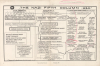
- Map The Nazi Fifth Column ~U.S.A.~
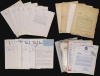
- Letters and memoranda regarding Kamp from the desk of Walter Winchell, covering from 1942 to 1944, some with attachments.
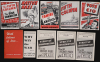
- 11 issues of The Hour, a short-lived Communist-leaning, or at least pro-Soviet newsletter, covering from 1940 to 1943.
- Various mimeographed newsclippings and reproductions of newsletters, mostly containing pro-Kamp articles, such as the KKK newsletter Fiery Cross.
- Letters to Winchell from the CIO (Oil Workers) and the 'Friends of Democracy.'
- 11 Kamp pamphlets and booklets, many excoriating Winchell, including 2 copies of With Lotions of Love to Walter Winchell and 3 issues of From the Secret Files of the FBI.
- Several mimeographed biographies of Kamp, with some duplication.
The Fifth Column Map
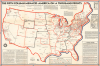
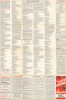
The visual high-point of the archive is Kamp's persuasive map, The Fifth Column Conspiracy in America. This striking 1941 map, issued by the Constitutional Educational League, led by Joseph P. Kamp, and co-published by Hearst editor A. Cloyd Gill, presents a charged visualization of the United States as threatened by a pervasive internal 'Fifth Column.' Drawing on the wartime paranoia of subversive elements operating within the United States, the map depicts what Kamp alleges is a nationwide network of communist, fascist, and Nazi-affiliated organizations embedded across American society. Kamp's United States is divided into notional administrative zones, including 'Communist districts' and 'Nazi departments,' while a dense system of symbols identifies purported headquarters, training centers, propaganda hubs, and related institutions.Beyond its cartography, the map is overt political messaging. Extensive text panels identify ideological groups Kamp argues have infiltrated key sectors - the armed forces, industry, and government - framing the threat as both immediate and pervasive. The reverse side expands on this conspiratorial narrative through a lengthy directory of organizations labeled as dangerous or subversive, ranging from expected political groups to labor unions and cultural associations.
Issued on the eve of America's 1941 entry into World War II (1939 - 1945), the map emerged amid suspicion and ideological anxiety. Although presented as a factual exposé grounded in investigative findings, its underlying purpose is polemical, emphasizing the perceived threat of communism above all else while conflating a wide range of political and social movements into a wide-reaching conspiratorial framework. It is a powerful example of mid-20th-century propaganda cartography, foreshadowing the heightened anti-communist rhetoric that would later characterize McCarthyism and the Cold War.
The Anti-Kamp Map
The archive also includes a smaller 1940 anti-Nazi map entitled The Nazi Fifth Column ~U.S.A.~, published as a centerfold in the November 1940 issue of The Anti-Nazi Bulletin. The map includes a three-column diagram overlaying an outline map of the United States. It connects Hitler and Nazi Germany with German and German-influenced foreign groups within the United States. These include the pro-Nazi German American Bund, Italian and Japanese Consulates, and several German business groups. These are further connected to 'mostly Nazi-inspired' 'Native Fascist Groups', which in this case include Kamp and his Constitutional Educational League.The Hour
The archive includes 11 issues of The Hour, some incomplete, spanning from 1940 - 1943. Each features a card pointing out Kamp-related content. The Hour was a short-lived American publication of the early 1940s associated with the writer and political activist Albert E. Kahn (1912 - 1979), best known for his later collaboration with Michael Sayers on Sabotage! The Secret War Against America (1942) and for his outspoken pro-Soviet views during World War II. The Hour emerged in the charged political climate of the period, when questions of fascism, communism, and U.S. foreign policy were intensely debated. The publication broadly reflected Kahn's ideological commitments, emphasizing anti-fascist messaging and, at times, arguments sympathetic to the Soviet Union, then an American ally against Nazi Germany. Like much of Kahn's work, it operated at the intersection of journalism and advocacy, blending reportage with polemic.Kamp's Phamplets
The archive includes 11 of Kamp's pamphleteering publications, including some of his most famous:- Native Nazi
- The Fifth Column vs. the Dies Committee
- Famine in America
- The Fifth Column in Washington
- Vote CIO and get a Soviet America
- From the Secret Files of the FBI (3 issues)
- Why Win the War and Lose what we're fighting for?
- With Lotions of Love to Walter Winchell
Other Content
Other content includes a host of letters, memoranda, photomechanically reproduced pages from various niche publications, and clippings associated with Kamp's 1944 Contempt of Congress hearing and his relentless attacks on Winchell. These are associated with several biographies of Kamp, with some textual overlap. There are also letters from the CIO Oil Workers Organizing Campaign and Friends of Democracy. Penciled notes by Winchell are scattered throughout.Outcome
Despite years of public and vitriolic fighting, both Kamp and Winchell were anti-communist and eventually aligned in support of Senator Joseph McCarthy and his 'Second Red Scare' (1950 - 1954). Their turn towards McCarthyism and the ultimate unpopularity of McCarthy's methods saw a decline in influence in both figures, but probably affected Winchell more. Winchell faded into obscurity and lived out his remaining days, while Kamp continued publishing conspiracy pamphlets until his death.Publication History and Census
These documents were written or published between 1941 and 1944. Kamp's published works appear on the market from time to time, although his large map is scarce, with OCLC noting just 8 distinct institutional holdings.Cartographers
Joseph Peter Kamp (April 28, 1896 - November 19, 1975) was a German-American political activist, conspiracy theorist, pamphleteer, and anti-communist writer best known for his leadership of the Constitutional Educational League. Born in New York City, he worked in journalism before turning to political advocacy in the 1930s, when he became a vocal critic of the New Deal, which he portrayed as a vehicle for collectivist, communist influence. Through pamphlets, books, and lectures, including The Fifth Column in the New Deal (1935), Kamp argued that subversive elements had penetrated American government and public life. His work anticipated and paralleled the climate of suspicion that later defined the Joseph McCarthy Era, of which Kamp was a staunch supporter, and he became associated with broader mid-20th-century anti-communist campaigns, including testimony before congressional committees and legal disputes over disclosure of organizational records. His critics accused him of being a Nazi-sympathizer. Though we find this unlikely, it is undisputed that he was an ardent anti-semite. Though influential among certain right-wing audiences, his views were widely regarded as extreme. He continued writing and organizing until his death in 1975. Further Details...
Alec Cloyd Gill (January 19, 1889 - April 7, 1943) was an American journalist and editor. Gill was born in Homer, Louisiana, and lived most of his life in Washington, D.C. Gill is most often associated with the Hearst Corporation, where he worked within the powerful newspaper network during a period of intense political polarization. Emerging from the tradition of Hearst editorial activism, Gill was known for strongly held anti-communist views, reflecting and reinforcing the broader climate of Cold War suspicion that characterized American media in the 1940s and 1950s. His writing and editorial stance aligned with the era's hardline opposition to perceived subversion, at times echoing themes associated with McCarthyism. He published several anti-communist maps and multiple pamphlets, some in conjunction with the conspiracy theorist and pamphleteer Joseph Peter Kamp (1896 - 1975). Further Details...
Walter Winchell (April 7, 1897 - February 20, 1972) was a highly influential Russian-Jewish-American newspaper columnist and radio broadcaster whose gossip-driven style helped pioneer modern celebrity journalism. Born in New York City, Winchell began performing in vaudeville around age 12 with Gus Edward's 'Newsboys Sextet'. He served in the U.S. Navy during World War I (1914 - 1918), achieving the rank of lieutenant commander. He afterward continued to serve with the U.S. Navy Reserve. His work in journalism began in the 1920s, with a focus on Vaudeville-related news. He slowly but surely transitioned to political commentary, but retained his theatrical and charismatic manner, drawing a large following. He rose to prominence through the 1920s and 1930s, developing a syndicated column and widely listened-to radio broadcasts, blending entertainment news with sharp commentary. During the 1940s and early 1950s, he became an ardent anti-communist and a vocal supporter of Joseph McCarthy, aligning himself with the broader climate of McCarthyism and using his platform to promote investigations and accusations of American communism. While immensely powerful at his peak, Winchell's influence declined rapidly in the late 1950s as public opinion turned against McCarthy. He spent his later years largely out of the spotlight and died in 1972. Further Details...
Condition
Very good. Measurements represent large 'Fifth Column' Kamp map. Smaller map, 11 x 16.5 in. Other documents measure roughly 8 1/2 x 11 in.