
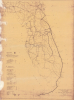
1921 / 1924 Florida East Coast Railway Diaotype Wall Map

This item has been sold.
Florida East Coast Railway Co... Map showing Connections and Locations.
Height of the FEC System.
- Digital Map Information
- Suitable for large format printing
- Full resolution TIFF file
- ICC color profile embedded
- Delivered instantly via download link
Height of the FEC System.
This 1921 Florida East Coast Railway engineering wall map, revised through 1924, was prepared by the company's Chief Engineer's Office in St. Augustine for internal reference. Its combination of railway connections, technical tables, and other information presents the transportation network near its height and during a period of breakneck development in South Florida. The map reflects the early 1920s expansion of settlement and agriculture, when rail access and drainage made new areas available to developers and farmers.A Closer Look
The map covers nearly all of Florida, except the western half of the Florida Panhandle. Heavy railway lines give the transportation network precedence over the finer county boundaries, waterways, and settlement names. Jacksonville anchors the northern connections, while the Florida East Coast route follows the Atlantic shoreline through St. Augustine, Palm Beach, and Miami before continuing across the Keys. (The Overseas Railroad, completed in 1912, was an engineering marvel of the time.) Inland branches and the railways of central and western Florida (operated by the Atlantic Coast Line, Seaboard Air Line, and others) place this coastal corridor within the larger regional network.Two legends and several tables of technical information occupy the bottom left, with tables on trackage, rails, equipment, and bridge capacities. The legend retains distinctions intended for a color-coded original, though the diazotype process renders them monochrome here.
The drainage canals associated with Lake Okeechobee introduce another engineering system into the railway geography. Their inclusion reflects the close relationship between hydrology, transportation, and settlement in this period of Florida's history. The 1892 expedition of James Edmundson Ingraham (1850 - 1924), then president of the South Florida Railroad, across the Everglades is also recorded. Ingraham subsequently entered the Flagler organization, serving as the Florida East Coast Railway's land commissioner. However, no railway along the route he surveyed, or otherwise running west-east across the Everglades, was ever built.
The Florida East Coast Railway
The Florida East Coast Railway was a major force in the development of Eastern Florida in the late 19th and early 20th century. Spearheaded by industrialist Henry Flagler, the Florida East Coast Railway fulfilled a vision dating back to at least the 1870s. Before Flagler, only a few rickety railroads unconnected to one another operated in Florida south of Jacksonville. Access to most Florida cities was limited to ferries and steamers. Flagler bought up most of the failing railroads, upgraded them, and connected them with new lines, first consolidating the network as the 'Jacksonville, St. Augustine, and Indian River Railway' and then, on September 9, 1895, as the 'Florida East Coast Railway'. The railroad reached New Smyrna in 1892, Cocoa in 1893, Palm Beach in 1894, and Miami in 1896. Flagler built sumptuous resorts and founded cities along the route, including The Ormond, the Royal Palm, the Royal Poinciana, the Continental, and more. Combined with his railroads and the Peninsular and Occidental Steamship Company (P. and O. S.S.), Flagler commanded a resort empire spanning the entire east coast of the Florida peninsula.Diazo Print or Whiteprint
The diazo print (whiteprint or diazo for short) is a photo-reproductive technique best understood as a reverse cyanotype or blueprint. The process yields distinctive blue lines on white paper. Like cyanotypes, the diazo process gained popularity in architecture circles as a simple, effective way to duplicate documents in the field. The earliest diazotypes appeared around 1880 and were adopted for military and field cartographic use from about 1895. The diazo process was commercialized in 1923, when the German firm Kalle and Company developed Ozalid, a patented diazo paper that made diazotyping even easier. By the 1950s, it supplemented cyanotypes as the reprographic technique of choice for technical drawings.Publication History
The map was prepared by the Florida East Coast Railway Company's Office of Chief Engineer in St. Augustine, and is dated 1921, revised through 1924. Available publications from the era indicate that the railway's chief engineer in 1921 was Henry N. Rodenbaugh, who became the FEC's General Manager by 1924. We have found no examples of this map, either as the original or a diazotype, in institutional collections or in market history.Cartographer
Henry Nathan Rodenbaugh (November 20, 1879 - January 15, 1966) was an American railway engineer and executive active in Pennsylvania and the southeastern U.S., particularly Florida, during the first half of the 20th century. Born in Norristown, Pennsylvania, he studied mechanical engineering at the University of Pennsylvania, graduating in 1901. That same year he married Frances Acker, with whom he had one daughter, but it appears to have been a short marriage, and in 1904 Rodenbaugh married Caroline Pickett Bransford, with whom he had at least three children. His early career included railway drafting, bridge engineering, terminal improvements, and valuation work for several eastern and southern railroads, including the Norfolk and Western and Southern Railway. He also worked on track elevation for the Philadelphia, Germantown and Norristown Railway. During federal control of the railroads, he served the United States Railroad Administration as engineering assistant to the director of its Southern Region, subsequently becoming regional engineer for the Southern and Pocahontas regions. In July 1920, he joined the Florida East Coast Railway as chief engineer, becoming general manager in January 1923 and vice-president in 1925, with responsibility for operation, traffic, construction, and valuation. His work included the construction of a railway bridge across the St. Johns River at Jacksonville and an extensive improvement program involving double tracking, bridges, and terminal construction. At St. Augustine, he chaired the study committee promoting the bridge subsequently known as the Bridge of Lions, still a landmark in the city. After leaving the FEC Railway in 1932, he undertook transportation consulting in New York and later directed railway work for Day and Zimmermann. He also served as a consulting engineer for Marine Studios at Marineland, Florida. In later life, he lived at Haverford, Pennsylvania, chaired an engineering consultancy, and served as president of the Haverford Civic Association. He died on January 15, 1966. Further Details...
Condition
Average. Water bleaching on the left side. Edge repairs.
References
Average. Water bleaching on the left side. Edge repairs.