
1855 Williams Chromolithograph View of Harrisburg, Pennsylvania

View of Harrisburg, Penn.
Striking early example of Chromolithographic Viewmaking.
- Digital Map Information
- Suitable for large format printing
- File Size: 51.36 MB
- File Type: ZIP / TIFF
- ICC color profile embedded
- Delivered instantly via download link
Striking early example of Chromolithographic Viewmaking.
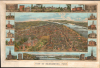
This is a rare 1855 J. T. Williams view of Harrisburg, Pennsylvania. It is a stunning early use of chromolithography for viewmaking. The view captures Harrisburg as a prosperous regional railroad hub, fast becoming the nation's 'coal gateway,' connecting the state's vast mineral wealth to the Atlantic coast and beyond.A Closer Look
The view looks south on Harrisburg from a middle-oblique perspective. The Susquehanna River flows on the right, and Paxton Creek is on the left. The state capitol building dominates the foreground; it was constructed in 1822 and destroyed by fire in 1897. The large street in front of the Capitol Park is North 3rd, and the transverse street in the foreground is likely North Street. The city is well served by railroads, most of which opened in 1854, just a year before this view was issued. These include the Pennsylvania Railroad (PRR) (1854), the Cumberland Valley Railroad (CVRR) (1837), and the Northern Central Railway (NCRY) (1854).Historical Context: Harrisburg
In 1855, Harrisburg, Pennsylvania, was emerging as a mid-Atlantic transportation and industrial hub. Situated along the Susquehanna River, the city became a key junction in the regional railroad network, served by the Pennsylvania Railroad, the Cumberland Valley Railroad, and the newly formed Northern Central Railway. These rail connections linked Harrisburg to major cities such as Philadelphia, Pittsburgh, Baltimore, and Chambersburg, fostering growth in commerce, manufacturing, and migration. As the state capital since 1812, Harrisburg also held political significance, and by mid-century, its economy benefited from ironworks, mills, and river trade, while its population steadily grew. The convergence of rail, river, and road made Harrisburg a strategic gateway between eastern markets and the American interior.Publication History and Census
This view is based on a daguerreotype photograph taken by John Thomas Williams around 1855. The photographic view was subsequently embellished, also by Williams, with a decorative and informative surround. It was engraved to chromolithographic stone by Edward Sachse of Baltimore. Rare. Reps notes holdings at the Library of Congress, the New York Historical Society, and the Pennsylvania Historical Society. No market history.Cartographers
John Thomas Williams (August 22, 1820 - January 25, 1905) was a photographer and daguerreotypist active in Baltimore, Maryland, and York, Pennsylvania, in the mid to late 19th century. Williams was born in Baltimore and was of English descent. His parents had emigrated to seek their fortunes, but died shortly after, leaving Williams orphaned. He was active as a photographer in Baltimore from 1850 - 1852, then in York from 1853 - 1857. His business thrived in York, winning numerous awards at the annual York County Fairs, until the Crisis of 1857, at which time he moved away from York, possibly to Harrisburg or back to Baltimore - it isn't clear. He returned to York a few years later to take a position as an adjuster for the Farmers' Fire Insurance Company, a position he held for the next 30 years. During this time, he was active in local fraternal circles and in the Democratic Party. He remained in York until he died in 1905. Further Details...
Edward Sachse (June 11, 1804 - May 20, 1873) was a German American artist, lithographer, and publisher. Born in Görlitz, Germany, Sachse operated a small lithographic firm and publishing house in Germany before immigrating to the United States in 1848. He settled in Baltimore, where he worked for E. Weber and Company briefly before opening his own firm, E. Sachse and Company, around 1850. Sachse was an early adopter of chromolithography, producing magnificent chromolithographs as early as 1855. During the 1850s, 1860s, and early 1870s, Sachse developed a reputation as the main lithographer of the Maryland - Washington D.C. area. One of his most recognizable accomplishments was the role he played in documenting the construction of the U.S. Capitol, along with other major building projects in Washington. He also created a massive twelve-sheet aerial view of Baltimore (which took three years and several artists to produce) and a four-sheet view of Syracuse. During the American Civil War, Sachse produced a series of lithographs of military campsites, hospitals, and barracks in Baltimore and Washington, D.C. Sachse sold these views at the bargain price of 25 cents to soldiers as souvenirs and often created multiple views of the same encampment when new regiments moved in, and the scenery, fortifications, and tents changed. Soldiers bought the prints and often mailed them home, sometimes with notes marking their specific tent. Sachse had a close working relationship with Charles Magnus (1826 - 1900), who published and sold many of Sachse's works. Sachse's firm also published advertising posters, book illustrations, labels, and business cards. Sachse died in Baltimore in 1873. Further Details...
Condition
Good. Closed tear extending from left margin about 7 inches into the printed area. Near imperceptible split repair along right vertical border of main image. Old mat burn around title.
References
Library of Congress, G3824.H3A3 1855.W5.