
1853 Kelsey Bird's-Eye View of Ridgefield, Fairfield, Connecticut

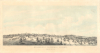

Ridgefield, Fairfield Co, Conn. From East Ridge. _ 1953.
Only recorded bird's-eye view of Ridgefield.
- Digital Map Information
- Suitable for large format printing
- File Size: 18.39 MB
- File Type: ZIP / TIFF
- ICC color profile embedded
- Delivered instantly via download link
Only recorded bird's-eye view of Ridgefield.
An unrecorded 1853 C. Kelsey and G. Hawyard 2-color chromolithograph bird's-eye view of Ridgefield, Fairfield County, Connecticut. Today, Ridgefield is considered one of Connecticut's most beautiful and historic towns, known for its well-preserved colonial downtown.A Closer Look
The view takes a low-oblique perspective looking westward on Ridgefield from a high point east of town - East Ridge (now a park). Main Street runs transversely through the view, along which most major buildings, including two churches, are evident. The church on the left with the tall steeple is most likely the Congregational Church, while the church at the center is a prior iteration of St. Stephen's Episcopal Church. A road heading east, out of town, with a solo rider heading into town and a four-wheel two-horse carriage heading out of town is likely Market Street.American Bird's-Eye City Views
The Bird's-Eye view industry emerged in the United States in the middle part of the 19th century and coincided with the commercial development of lithographic printing. Before the rise of lithography, the ability to own and display artwork in the home was largely limited to the extremely wealthy, but the advent of lithographic printing made it possible for everyone to own visually striking artwork. A robust trade developed in portraits of political leaders, allegorical and religious images, and city views.City views were being produced in the United States as early as the 1830s, but the genre exploded after the American Civil War (1861 - 1865). Bridging the gap between maps and pictures, most 19th-century American bird's-eye views presented cities to the public from high points. Some were imagined, but others were drawn from hot-air balloons or nearby hills. The presentation, combining high elevation, commercial interest, and new printing technology, created a uniquely American art form, as described by historian Donald Karshan,
Some print connoisseurs believe that it was only with the advent of the full-blown city-view lithograph that American printmaking reached its first plateau of originality, making a historical contribution to the graphic arts. They cite the differences between the European city-view prints and the expansive American version that reflects a new land and a new attitude toward the land.The vogue for bird's-eye city views lasted from about 1845 to 1920, during which period some 2,400 cities were thus portrayed, some multiple times. Although views were produced in many urban centers, the nexus of view production in the United States was Milwaukee, Wisconsin. The major American viewmakers were Stoner, Wellge, Bailey, Fowler, Hill, Ruger, Koch, Burleigh, Norris, and Morse, among others.
Chromolithography
Chromolithography, sometimes called oleography, is a color lithographic technique developed in the mid-19th century. The process uses multiple lithographic stones, one for each color, to yield a rich composite effect. Generally, a chromolithograph begins with a black basecoat upon which subsequent colors are layered. Some chromolithographs used 30 or more separate lithographic stones to achieve the desired effect. Chromolithograph color can be blended for even more dramatic results. The process became extremely popular in the late 19th and early 20th centuries when it emerged as the dominant method of color printing. The vivid color chromolithography made it exceptionally effective for advertising and propaganda.Publication History and Census
This view was drawn in 1853 by C. Kelsey and printed in lithograph by George Hayward of New York. It is one of 3 known views produced after Kelsey, the others being Catskill, New York, and New Haven, Connecticut. Only the Catskill view is recorded in Reps. This is one of two known examples of the Ridgefield view, both in our hands.Cartographers
C. Kelsey (fl. c. 1850 - 1860) was an American landscape and portrait artist based in New York. We note three views attributed to Kelsey: Catskill, New York (Pease, 1853), New Haven, Connecticut (1853), and Ridgefield, Connecticut (Hayward, 1853), all seemingly from the same series, but only the first of which appears in Reps' Views and Viewmakers of Urban America (University of Missouri, Columbia, 1984). We note no other views, although there are anecdotal and auction records for a few oil paintings, mostly portraiture. Further Details...
George Hayward (fl. c. 1850 - 1870) was an American lithographer based in New York City in the middle to late 19th century. Hayward's imprint appears on numerous 19th century maps associated with the Manual of the Corporation of New York, published at various times by David T. Valentine and Joseph Shannon. He also did similar work for William Bishop and Henry McCloskey of Brooklyn. He was involved in various partnerships, publishing at various times as Hayward, States and Koch (171 Pearl Street), Hayward and Lepine (171 Pearl St). Today he is memorialized by Heyward Street in South Williamsburg, Brooklyn. Further Details...
Condition
Very good.