
1860 Shurtleff View of Winchendon, Massachusetts

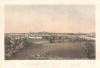
Winchendon, Mass, 1860, from Residence of Henry Wyman.
New England's 'Toy Town'.
- Digital Map Information
- Suitable for large format printing
- Full resolution TIFF file
- ICC color profile embedded
- Delivered instantly via download link
New England's 'Toy Town'.
This is a rare c. 1860 bird's-eye view of Winchendon, Massachusetts, drawn by Roswell Morse Shurtleff. It displays the town on the eve of the U.S. Civil War, when early signs of industrialization were changing the face of the town.A Closer Look
The view looks at Winchendon, near the New Hampshire border, from the home of Henry Wyman on the outskirts of the town. The Millers River can be seen flowing alongside the main part of the town, which sits on the other side (suggesting an orientation looking towards the north). Three church steeples and numerous homes are illustrated, with scattered trees and buildings on the hills in the distance. Perhaps most interesting is the tall flagpole at left, with a flag bearing the word 'Lincoln,' referring to the preferred presidential candidate of most voters in Massachusetts in that year's election.Around the time of this view's production, Winchendon's economy largely revolved around Millers River, which powered mills for a variety of industries, including textiles and furniture. In the years before this view was drawn, railroads added connections to further markets, namely the Cheshire Railroad, seen at right here near the sailboat plying the river. Soon after this view was drawn, the town would become known throughout New England and the country thanks to Morton E. Converse (1837 - 1917), who became a major manufacturer of wooden toys operating out of Winchendon, earning Winchendon the nickname 'Toy Town.'
Publication History and Census
This view was originally drawn by artist Roswell Morse Shurtleff, among his earliest such works, and then was prepared as a lithograph by John Perry Newell (who signs his name on a small board above the stone wall at bottom-left) and printed by J. H. Bufford in Boston. This map is unusual in that it is printed on very fine tissue, which was then laid on a larger sheet, on which the title is printed. This is not a printing model we have encountered previously. It is generally cataloged as 1860, but could have been printed several years afterward. It is only cataloged among the holdings of the Boston Athenaeum, which holds two examples, and the Winchendon Historical Society, with no known market history.Cartographers
Roswell Morse Shurtleff (June 14, 1838 - January 6, 1915) was an American painter and illustrator. Born in Rindge, New Hampshire, Shurtleff studied at Dartmouth College and the Lowell Institute in Boston. He briefly managed an architect's office in Manchester, New Hampshire before moving to Buffalo and working as a lithographer in 1858-1859. Afterwards, he returned to New England and briefly lived in Winchendon, Massachusetts, where he drew a view of the town that was later printed by J. H. Bufford. He then moved to New York City to attend the Academy of Design. At the start of the U.S. Civil War, Shurtleff volunteered with the 99th New York Volunteers, later the 99th New York Infantry Regiment, which, despite its name, functioned like a Coast Guard unit. Shurtleff was captured very early in the conflict (by one account he was the first Union officer to be taken prisoner after being shot) and spent eight months in a Confederate prison, where he was asked to design a flag for Gen. Beauregard's daughter that later influenced the design of the Confederate flag. After the war, he married Clara Eugenia Halliday and moved to Hartford, Connecticut before returning to New York City by the mid-1870s. During these years, he worked as an illustrator for magazines, books, and newspapers, and later shifted to paintings, typically of animals and landscapes, for which he is best known. Shurtleff worked in a variety of methods and media, including sketches, oil, watercolor, lithography, and photogravure. By the late 1880s, Shurtleff was recognized as one of the premier American landscape painters of the day, if fairly conservative and conventional in his approach. He was an active member of the National Academy of Art and the National Academy of Design. Further Details...
John Perry Newell (January 27, 1832 - April 20, 1898) was a New England lithographer and naval painter active in the mid-19th century. Newell was born in Newport, Rhode Island. Newell apprenticed under John Bufford (1810 - 1870) in Boston. He was drafted into the Union army in 1863 to fight in the Civil War (1861 - 1865). Afterwards, he returned to Newport where he established himself as an artist and lithographer. He traveled extensively in New England creating paintings for lithograph. His work proved popular with wealthy visitors to the Newport Summer Colony, and he was acclaimed at the 1866 Pennsylvania Academy. He left new England in 1882 and moved to Brighton, England, where he died in 1898. Further Details...
John Henry Bufford (July 27, 1810 - October 8, 1870) was a Boston based lithographer and printer. Bufford was born in Portsmouth, New Hampshire. He apprenticed as an artist and lithographer at Pendleton Lithography (1825 - 1836) of Boston. In 1835 he relocated to New York where he took independent commissions from George Endicott and Nathaniel Currier, among others. Returning to his hometown of Boston in 1839, he took a position of chief artist with the firm of Benjamin W. Thayer, heir to Pendleton Lithography. He probably married Thayer's sister, Anna Melora Tufts Thayer (1808-1878). Bufford has been highly criticized as an engraver, with one historian, David Tatham, stating he had 'a mediocre sort of craftsmanship at best' and 'no very special skills as an original artist.' We, however, find no justification for this harsh criticism. Instead Bufford gravitated toward business and management. By 1844 Thayer's shop was renamed J. H. Bufford and Company. The firm specialized in decorative sheet music, panoramic views, illustrations for books, retractions of paintings, and commercial printing. Bufford is credited with being one of the first employers and mentors of the important artist and engraver Winslow Homer. Bufford died in 1870, passing on the business to his sons Frank G. Bufford and John Henry Bufford Jr. These young men, operating under the imprint of 'J.H. Bufford's Sons, Manufacturing Publishers of Novelties in Fine Arts', expanded the firm with offices in New York and Chicago. A possibly related lithographic printing firm named Bufford Chandler was incorporated in Boston in 1893. It later relocated to Concord, New Hampshire but closed in 1925 when its state business charter was repealed. Further Details...
Condition
Good. Backed on heavy linen. A few minor surface abrasions.
References
Reps 1688. Boston Athenaeum Call No. D B64W71 V.g.(no.1), D B64W71 V.g.(no.2).