
Rowse, Samuel Worcester

Samuel Worcester Rowse (January 29, 1822 - May 24, 1901) was an artist, engraver, and lithographer who spent most of his life and career in Boston, Massachusetts. Census records and obituaries disagree on whether he was born in Maine or New York, but he was raised and began his career in Maine. Though Rowse originally worked as an engraver, he moved to Boston in 1852 and opened a lithography studio. But he became best-known for pastel and charcoal portraits of leading intellectuals and political figures of the day. He traveled in the same intellectual circles as Ralph Waldo Emerson, Henry David Thoreau, Nathaniel Hawthorne, and Henry Wadsworth Longfellow, and drew celebrated portraits of each. Rowse was also associated with the abolitionist movement, and produced a famous lithograph in 1850 titled 'The Resurrection of Henry Box Brown at Philadelphia,' based on the story of an enslaved man who escaped to freedom by hiding in a box being mailed from Richmond, Virginia, to Philadelphia. Rowse traveled widely, relocating from Boston to New York in 1880, and briefly living in London and Paris at various points of his life.
Boston's First Modern System of Piped Water.
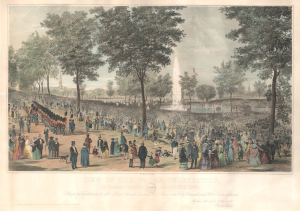
View of the Water Celebration, On Boston Common, October 25th 1848.
$2,000.00
Acquire
- Digital Map Information
- Suitable for large format printing
- DPI: 600
- File Size: 55.98 MB
- File Type: ZIP / TIFF
- ICC color profile embedded
- Delivered instantly via download link
A striking hand-tinted 1848 lithograph view depicting Boston Common during a ceremony to celebrate the opening of a publicly-administered city water supply system. The introduction of a public water system transformed Boston and, despite much debate, inaugurated an age of large-scale civil infrastructure projects that transformed Boston and other American cities. (more details)