
Hill, Albert Banks

Albert Banks Hill (May 28, 1847 - January 2, 1930) was a civil engineer active in Connecticut in the late 19th and early 20th centuries, best known for planning the sewage systems of Danbury and New Haven. Hill was born in Redding, Connecticut and educated at local schools before briefly attending a preparatory school and then matriculating at the Sheffield Scientific School (part of Yale University) and completing his degree in 1869. Afterwards, he taught at his alma mater and began working for the City of New Haven, initially as first assistant engineer and then as City Engineer from 1883 to 1892, after which he launched his own private consulting business. This firm employed and trained many students and graduates of the Sheffield Scientific School. In addition to his work in New Haven and Danbury, Hill also helped design the water systems of Greenwich and Litchfield. Aside from his work in water and sewage systems, he also helped lay out New Haven's network of streetcars (electric railways), improved harbors, and designed depot approaches for the New York, New Haven and Hartford Railroad. Hill also served terms as the Director of the American Society for Civil Engineers and the President of the Connecticut Society of Civil Engineers. Hill produced several maps of New Haven as well as schematic map of Yale's campus in 1922. After his death, Hill's great-nephew, Orson Hill Marchant (1882-1938), who had been working for Hill since 1904, took over his office with Clarence M. Blair, operating the consulting business as Blair and Marchant, Inc. until Marchant's death.
Reshaping Campus and City Alike.
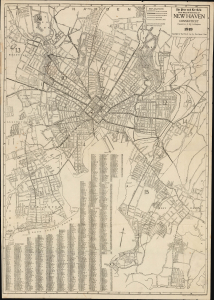
The Price and Lee Co's New Map of the City of New Haven, Connecticut.
$250.00
Acquire
- Digital Map Information
- Suitable for large format printing
- Full resolution TIFF file
- ICC color profile embedded
- Delivered instantly via download link
This is a 1919 city plan or map of New Haven, Connecticut, prepared by civil engineer A. B. Hill for the Price and Lee Company. It captures the city in the immediate post-World War I era, when both it and Yale University were undergoing significant changes. (more details)