
Kishida Ginkō (岸田吟香, Kishida Ginkaku, Goshika Kishida)
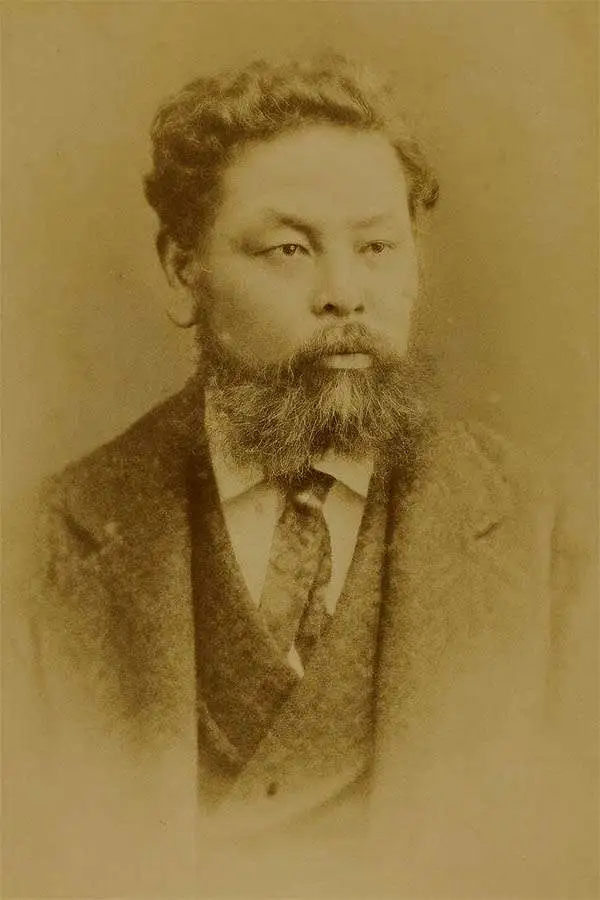
Kishida Ginkō (岸田吟香; June 15, 1833 - June 7, 1905) was a Japanese businessman, journalist, educator and sinologist. He was born in Mimasaka, Okayama to a wealthy family and studied Confucian classics with the scholar Hayashi Fukusai (林復斎, 1801 - 1859). He then moved to Osaka to continue studies in Confucian classics at the Hakuen Shoin (泊園書院), a forerunner to Kansai University, and continued his studies in Edo with Fujimori Koan (藤森弘庵). During this period, the Tokugawa Shogunate accused him of subversive activities, forcing him to flee the capital, going underground and working menial jobs in bathhouses and brothels. Operating under a pseudonym, Kishida became owner of a brothel in Yoshiwara and came into contact with the missionary and translator James Curtis Hepburn (1815 - 1911). Kishida's clear intellectual abilities and familiarity with Chinese classics earned him a spot on Hepburn's project to write a bilingual Japanese-English dictionary. Kishida also landed a job with Joseph Heco (Hikozō Hamada, 浜田彦蔵) publishing Japanese translations of foreign newspaper articles (海外新聞) in Yokohama. In 1866, Kishida traveled to Shanghai with Hepburn to proofread the draft of the dictionary they had compiled, which was to be published by the Presbyterian missionary printer Meihua Shuguan (美華書館). He also began to operate a medical business, selling eye drops which he had been introduced to by Hepburn (who originally trained as a physician). In 1873, Kishida was hired as an editor by the Tokyo Nichi Nichi Shimbun (東京日日新聞), quickly emerging as one of Japan's leading newspapers. He served as a war correspondent during Japan's 1874 punitive expedition to Taiwan and wrote a series of 'chronicles' of the conflict that were widely read in Japan. While working as a journalist, he also continued to expand his medical business (Rakuzendo), which he devoted himself to full time from 1877. He opened a branch of Rakuzendo in Shanghai soon afterwards and began to become a public advocate for closer relations between China and Japan (often a euphemism for increased Japanese influence in China), taking a leading role in trade, educational, and political organizations dedicated to the cause. Kishida worked to spread medical knowledge in China, promoting a hybrid of Western medicine and traditional Chinese medicine. While living in China he traveled extensively developing an interest in Chinese geography. As he was based in China at this time, Kishida can arguable be considered China's first modern cartographer. He adopted western methodologies to existing Chinese cartography, which he updated and revised with his own survey work. In addition, Kishida espoused a cartographic philosophy influenced by the German geographer Karl Ritter (1779–1859), whose Erdkunde emphasized a dynamic interaction between nature and human society. Late in life, he dedicated himself to a comprehensive geographical text of Qing China (清国地誌) but did not finish the text before his death. A larger-than-life figure in many respects, Kishida and his wife Katsuko had twelve children, several of whom were prominent in the art and business world. His most famous child was the painter Ryoo Kishida.
AKA: 岸田吟香, Kishida Ginkaku, Goshika Kishida
We're Still Hunting
We don't yet have any maps by this cartographer in stock — but that's more a matter of timing than availability. New acquisitions arrive regularly, and pieces from this maker do surface. Check back soon, or reach out if you're specifically looking for one — we're always happy to keep an eye out.
Have a map by this cartographer you're looking to sell? We'd love to hear from you.