
Kuniteru II (二代目 歌川国輝)

Kuniteru II (二代目 歌川国輝; c. 1830 - December 15, 1874), also known as Kunitsuna II, was a Japanese ukiyo-e (nishiki-e) artist of the Utagawa School. Despite his pen name, he was actually more directly a disciple of Kunisada (歌川国貞, 1786 - 1865, also known as Toyokuni III) than of Kuniteru (fl. c. 1818 - 1860). Like other artists of the Utagawa school in the late Edo and early Meiji periods, Kuniteru II produced a wide range of works, including depictions of foreigners and foreign influence in Japan, and the drastic changes underway in Japanese society. He was best known for a series of views of famous places in his native Tokyo, along with depictions of railways and a group of prints produced for schoolchildren commissioned by the new Ministry of Education in 1873. Along with Kunisada II (1823 - 1880), he is among the last of the prominent artists of the Utagawa school.
AKA: 二代目 歌川国輝
Renovating Nihonbashi.
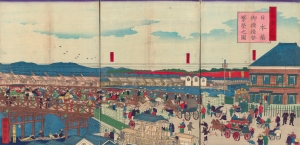
東京第一名所 日本橋御摸檨替繁榮之圖 / [Famous Places of Tokyo No. 1 View of the Prospering Nihonbashi Replacement Bridge].
$2,000.00
Acquire
- Digital Map Information
- Suitable for large format printing
- Full resolution TIFF file
- ICC color profile embedded
- Delivered instantly via download link
An engaging 1873 Ukiyo-e triptych produced by Kuniteru II depicting the new Nihonbashi Bridge in Central Tokyo. The most culturally significant bridge in Japan, the historical terminus of the Tōkaidō highway, the Edo-era arched bridge had been replaced by a Western-style flat bridge the year before this print's publication, both a practically and symbolically important change. (more details)