
Quiroule, Pierre (Joachim Alexis Falconnet, Joaquín Alejo Falconnet)
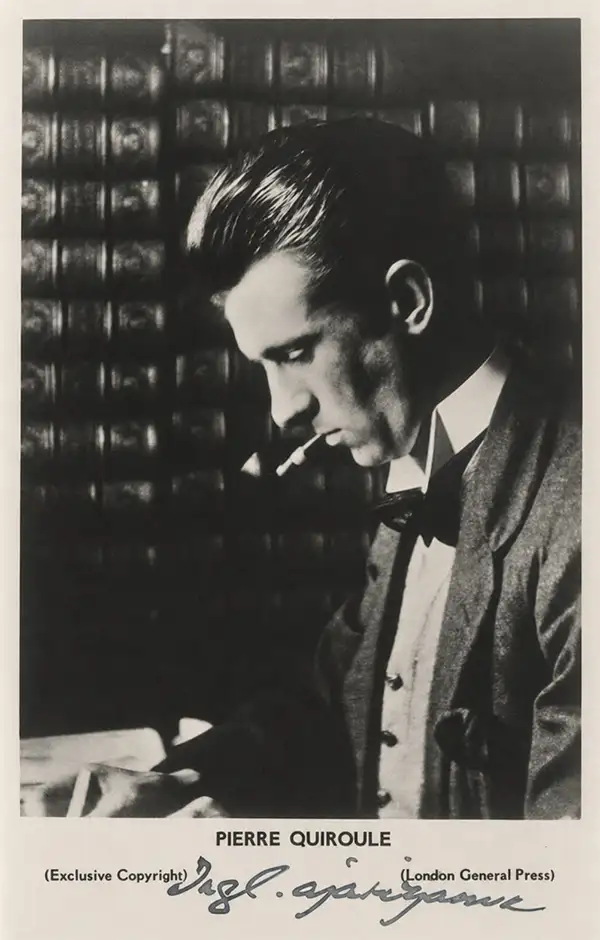
Pierre Quiroule (Joachim Alexis Falconnet, Joaquín Alejo Falconnet; March 1, 1867 - November 30, 1938), the principal pseudonym of Joachim Alexis Falconnet, later Hispanicized as Joaquín Alejo Falconnet, was a French-born Argentine journalist, typographer, playwright, novelist, and anarchist social theorist. Born in Villefort, Lozère, into a family based in Lyon, Falconnet emigrated to Buenos Aires as a child and trained as a typographer. After briefly associating with the Unión Cívica Radical and participating in its unsuccessful 1893 uprising, he entered Argentina's anarchist circles, adopting the name Pierre Quiroule - a play on the French expression pierre qui roule [rolling stone]. From 1893 to 1894, he and Alexandre Sadier directed the French-language anarchist weekly La Liberté, which advanced a Kropotkin-inspired anarcho-communism and advocated direct revolutionary action. He subsequently contributed to such libertarian publications as El Perseguido, Le Cyclone, La Protesta, Sembrando Ideas, and Barcelona's La Revista Blanca, while lecturing at educational societies and rationalist schools. Beginning in 1904, he worked as a typographer at Argentina's Biblioteca Nacional under Paul Groussac, remaining there until 1926. Quiroule wrote plays, philosophical essays, political pamphlets, and three major works of utopian fiction: Sobre la ruta de la Anarquía (1912), La Ciudad Anarquista Americana (1914), and En la soñada tierra del Ideal (1924). The second, his best-known work, transformed anarchist principles into an elaborate futuristic city whose rational plan embodied communal ownership, participatory government, technological progress, sexual freedom, and the abolition of the traditional state and family. Disillusioned by factional divisions within the anarchist movement, Quiroule withdrew from active militancy around 1925. Following the death of his companion, Andrea Brasseur, in 1926, he left Buenos Aires. He spent several years in relative isolation at Posadas, Misiones, an experience that inspired Un Filósofo en Posadas (1931). He later returned to Buenos Aires, worked as a proofreader for La Nación, and contributed to the anarchist journal Nervio. Quiroule died in Buenos Aires in 1938, leaving an unusually broad body of work that joined political activism, futurism, speculative philosophy, literature, and urban planning into one of the most distinctive expressions of Argentine anarchist utopianism.
Quiroule, Pierre is also known as: Joachim Alexis Falconnet, Joaquín Alejo Falconnet
Futuristic city of Anarchy, with a death ray.
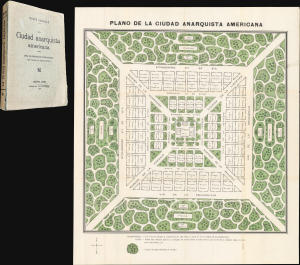
La Ciudad Anarquista Americana. / La Ciudad Anarquista Americana: Obra de Construcción Revolucionaria.
$3,750.00
Acquire
- Digital Map Information
- Suitable for large format printing
- Full resolution TIFF file
- ICC color profile embedded
- Delivered instantly via download link
This is a rare 1914 color-printed folding plan of French-Argentine Pierre Quiroule's Ciudad Anarquista Americana, a cartographic vision of an ideal anarchist city. Conceived as the physical setting for Quiroule's revolutionary utopian novel, La Ciudad Anarquista Americana: Obra de Construcción Revolucionaria, the plan translates radical political and social philosophy into a rigorously ordered urban landscape of monumental avenues, communal institutions, gardens, schools, and public gathering places. (more details)