
Sawamuraya Seikichi (沢村屋清吉)

Sawamuraya Seikichi (沢村屋清吉; c. 1855 - 1903), from 1876 known as Takekawa Seikichi (武川清吉 or 竹川清吉), was a late Edo - Meiji period printer and publisher of Ukiyo-e (nishiki-e) works, including those by leading artists of the day such as Kunisada II, Hiroshige III, Toyohara Kunichika, Kobayashi Kiyochika, and Kuniyoshi. Sawamuraya began publishing books with illustrations c. 1855 but switched to standalone actor and warrior prints from the mid-1860s (the latter in conjunction with Maruya Tetsujirō 丸屋鉄次郎). Originally located in Kanda on the outskirts of Tokyo, in 1881 he relocated to a more central location in Nihonbashi. In the late 1880s, the firm began to publish under the names Takekawa Unokichi (武川卯之吉) and Takekawa Unosuke (武川卯之助; fl. c. 1888 - 1912), thought to be sons of Takekawa Seikichi.
AKA: 沢村屋清吉
Rare Ukiyo-e: Building a Bridge to Modernity.
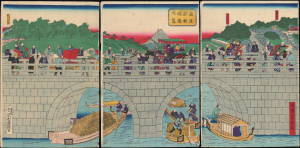
筋違新眼鏡橋弌覧 / [The New Megane Bridge at a Glance].
$1,600.00
Acquire
- Digital Map Information
- Suitable for large format printing
- File Size: 28.92 MB
- File Type: ZIP / TIFF
- ICC color profile embedded
- Delivered instantly via download link
This is Utagawa Yoshitora's c. 1873 Ukiyo-e woodblock triptych of the New Megane Bridge near Tokyo. The view presents Japanese society at the start of the Meiji era, rooted in the traditions of the Edo period but rapidly adopting new influences from abroad. (more details)
Origins of Modern Japan's Banking System.
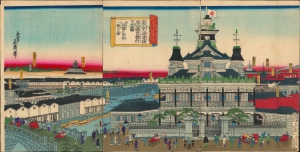
東京海運橋第一國立銀行の全圖并近圓の市中一覽の圖/ [Complete View of the First National Bank at the Tokyo Kaiun Bridge, with a View of the Nearby Cityscape].
$3,000.00
Acquire
- Digital Map Information
- Suitable for large format printing
- Full resolution TIFF file
- ICC color profile embedded
- Delivered instantly via download link
This stunning 1876 Ukiyo-e triptych, depicting the Dai-Ichi Bank Building in Tokyo, was drawn by the artist Yoshitora and published by Takekawa Seikichi. Both the bank and its building, along with several other financial institutions in the same area, were key signifiers of Japan's modernization in the early Meiji period. (more details)