
Tavernier, Melchior, I

Melchior Tavernier I (1564 - 1641) was a French engraver of Flemish descent. Born in Antwerp, he was the son of Gabriel Tavernier and father of Melchior Tavernier II (1584 – 1665). He may have studied under Ortelius in Antwerp. His father Gabriel Tavernier is credited for introducing the roller press to Paris. He had the distinction of being Imprimeur en Tailles-douces de la Maison de Sa Majesté. Tavernier's workshop was located near the Pont Marchand, where apparently several other printers, including Gobert and Collet, also maintained businesses. Melchior Tavernier is the brother of the celebrated writer and traveler Jean-Baptiste Tavernier (1605-1689). Tavernier engraved several important maps for figures such as Samuel de Champlain, and others. Melchior Tavernier II's work is difficult to distinguish from that of his son, Melchior Tavernier II.
Champlain's lost map of the Great Lakes, printed in 1664 from his original copperplate: a landmark of exploration whose true origins lay hidden for three centuries.
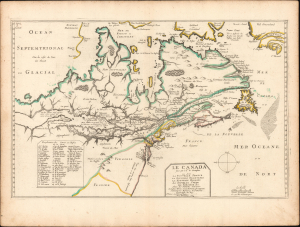
Le Canada faict par le Sr. de Champlain ou son La Nouelle France, La Nouvelle Angleterre, La Nouvelle Hollande, La Nouvelle Svede, La Virginie…
$14,000.00
Acquire
- Digital Map Information
- Suitable for large format printing
- Full resolution TIFF file
- ICC color profile embedded
- Delivered instantly via download link
This is a 1664 Pierre Du Val issue of one of the great maps of North American discovery: Samuel de Champlain's long-lost 1616 map, engraved after his extraordinary journey into the Great Lakes region and first printed in 1653 from Champlain's original copperplate. It preserves the geographical revelations of Champlain's 1615-16 expedition, when travel with Indigenous allies carried him deep into the continental interior and transformed European understanding of the Great Lakes. Intended for Champlain's account of these discoveries, the map lay unfinished for four decades before Du Val completed the engraving and published it in 1653. This example belongs to that remarkable publishing history, through which the major work of Champlain's exploration finally reached the public. Its true origins remained unrecognized until 1953 - exactly 300 years later! - when the discovery of an unfinished impression at the John Carter Brown Library revealed that beneath Du Val's additions survived Champlain's own lost map. (more details)