
Weigel, Erhard (Erhardi Weigelij, Erhardus Weigelius)
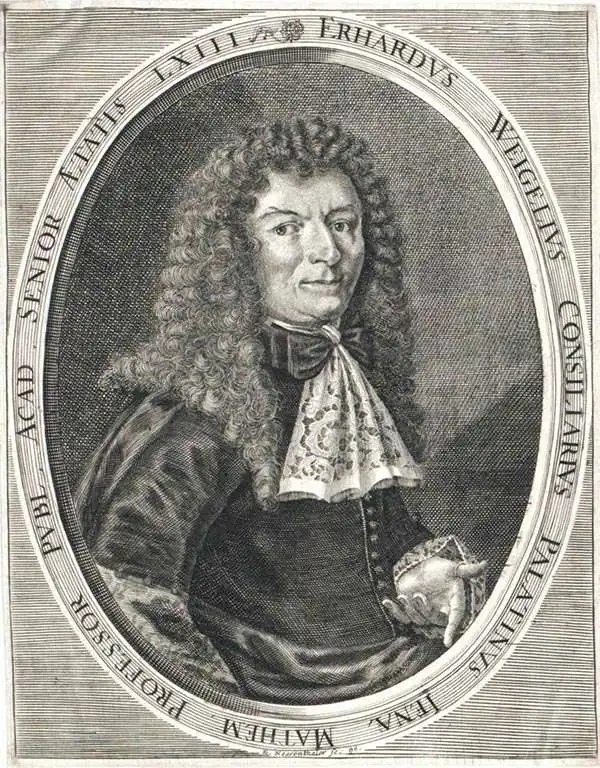
Erhard Weigel (Erhardi Weigelij, Erhardus Weigelius; December 16, 1625 - March 20, 1699) was a German mathematician and astronomer notable for his efforts to popularize science and make it accessible to the general populace Professionally, is best known for the concept of Mathesis Universalis (Universal Mathematics) - mathematics was not simply a computational tool, but rather a universal language capable of bringing clarity and certainty to every discipline. He was very active in the observation of the comet that appeared between 1664 and 1665. Weigel was born in Weiden in der Oberpfalz, the son of clothiers, Michael and Anna Weigel. Little is known of his youth, except for its frequent disruption by the religious wars of the period. In 1644, he attended the Gymnasium in Halle, where he studied under the guidance of the astrologer Bartholomäus Schimpfer (???? - 1662). He went on to study at the University of Leipzig, earning his MA in 1650. Two years later, he earned his habilitation, indicating that he could independently teach PhD candidates - the highest accreditation. The polymath Gottfried Wilhelm Leibniz (1646 - 1716), along with Isaac Newton, the inventor of calculus, was his most famous student. For his entire adult career, he served as a professor of mathematics at Jena University (Thuringia, Germany). The lunar crater Weigel is named after him.
AKA: Erhardi Weigelij, Erhardus Weigelius
Quod est superius est sicut quod est inferius, et quod inferius est sicut quod est superius.
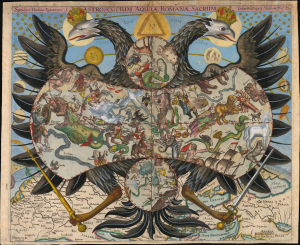
Speculum Uranico-Romanum S. Astroscopium Aquilae Romanae Sacrum Erhardi Weigelis Mathem. Prof. P. Jena.
$20,000.00
Acquire
- Digital Map Information
- Suitable for large format printing
- Full resolution TIFF file
- ICC color profile embedded
- Delivered instantly via download link
This is Erhard Weigel's rare and striking 1661 astroscopium, or allegorical chart of the constellations, framed by the janiform eagle of the Holy Roman Empire. The map is titled 'Speculum Uranico-Romanum', which translates to 'Roman Celestial Mirror', underscoring the mirroring of the celestial and political realms. As-above-so-below, the map presents Weigel's cosmographical framework, in which astronomy (mathematics) and politics were divinely sanctioned and mutually reinforcing: astronomy revealed God's mathematically ordered universe, while the Holy Roman Empire embodied His ordained Christian order. This fascinating image underwent several changes during its printing history: the present example is likely a proof state. (more details)