
Wilson, George
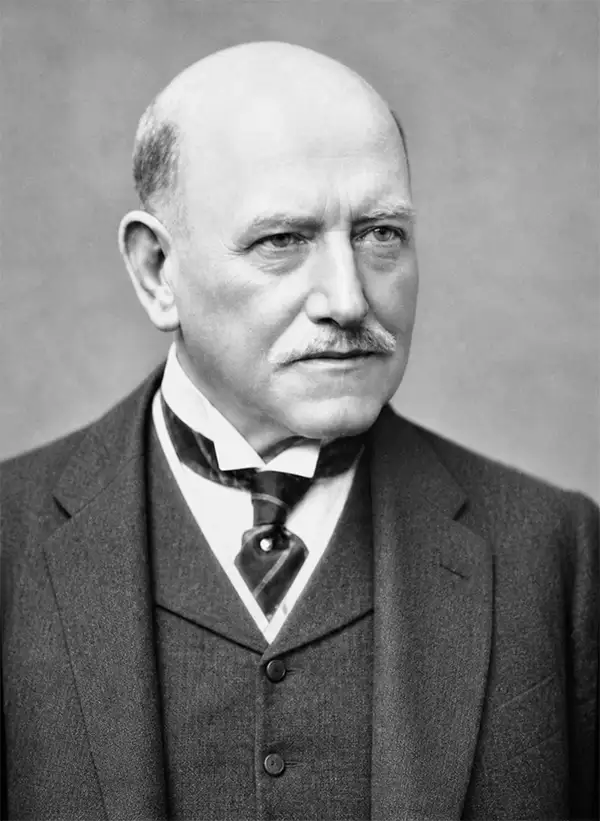
George Wilson (May 13, 1862 - December 12, 1943) was a British soldier, explorer, and colonial administrator in East Africa. He was born in Glasgow as the eldest of nine children. When he was five years old, Wilson moved to Australia where he had a rough-and-tumble youth, including working as an entertained and in a coal mine. Possessing natural leadership skills, Wilson became a director of the coal mine and leader in a local regiment he had raised, but troubles in his personal life and the collapse of his first marriage led Wilson to pursue missionary work in East Africa, where he taught freed and runaway slaves. There he encountered Frederick Lugard, who asked that Wilson be hired by the Imperial British East Africa Company and join his first and second Sabaki River expeditions, serving as second-in-command on the latter. Wilson fell ill however on both occasions and on the second expedition very nearly died, only being saved by the quick and dedicated efforts of Lugard. Nevertheless, he had gained a reputation as an effective interlocutor with local peoples, having learned multiple local languages, including Swahili and Masai, from his two African wives (one of whom he had at least one child with, a son named Edward). After the Sabaki expeditions, Wilson was involved in a complex and somewhat obscure conflict with the forces of Waiyaki Wa Hinga, hitherto an ally of the British, as the IBEAC outpost of Dagoretti, which had to be abandoned as a result. Afterwards, he worked for several years for the IBEAC, including overseeing the construction of the 185-mile-long Mackinnon Road from Mazeras (near Mombasa) to Kibwezi. In August 1894, Wilson joined the civil service of the Uganda Protectorate, quickly rising through the ranks, and by November 1897 was the Acting Commissioner and Commander-in-Chief of the Uganda Protectorate, and would holding leading positions in the protectorate for the next decade. Among locals, he was nicknamed bwana tayari ('Mr. Ready') for his deep knowledge of local peoples and languages. His tenure was marked by spillover from the Mahdist War in Sudan and the revolt of Mwanga II of Buganda, who resisted, then sided with, then resisted again the British over the course of the late 1880s and 1890s. Wilson played a crucial role in arranging the British administration of Uganda, negotiating with local elites and granting them wide latitude for managing their own affairs as long as they cooperated with the British on some key issues such as abolitionism. Despite his unusually deep understanding of local cultures, Wilson maintained the paternalistic attitude of British imperialism, seeing locals as little more than children who required British tutelage. The positive side of his paternalism was that he committed his efforts, in addition to abolitionism, to education, famine relief, and early public health measures. He also is credited with driving the first car on Kenyan soil, a De Dion-Bouton, in December 1903. Wilson retired from his post in Uganda in 1909 due to poor health and moved to England. In 1900, he had married Clarissa Adelina Humphreys (d. 1958), who remained with him in East Africa until their joint relocation to England.
The Foundation for British Rule in East Africa.
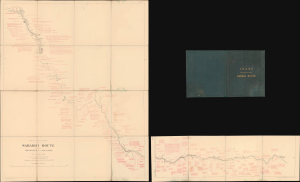
Rough Road Chart of Sabakhi Route from Makangeni to Machagos.
$2,500.00
Acquire
- Digital Map Information
- Suitable for large format printing
- Full resolution TIFF file
- ICC color profile embedded
- Delivered instantly via download link
This rare 1890 map of Kenya illustrates Frederick Lugard's first expedition along the Sabaki River between Mombasa and Machakos. The expedition and Lugard's subsequent public pressure campaign were important steps in establishing a British 'sphere of influence' and, eventually, protectorates over Kenya (British East Africa) and Uganda. (more details)