
Buy de Mornas, Claude

Claude Buy de Mornas (17xx - 1783) was a French geography professor. He published the Atlas Méthodique et Elémentaire de Géographie et d'Histoire jointly with Louis-Charles Desnos (1725 - 1805) in 1761. Desnos claimed the plates for the Atlas Méthodique after Buy de Mornas died.
The Milky Way, Ursa Major, and the North Star.
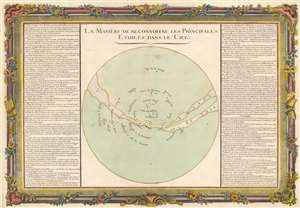
La Manière de Reconnoitre les Principales Etoiles dans le Ciel.
$350.00
Acquire
- Digital Map Information
- Suitable for large format printing
- DPI: 600
- File Size: 51.09 MB
- File Type: ZIP / TIFF
- ICC color profile embedded
- Delivered instantly via download link
This is a 1761 Claude Buy de Mornas celestial map of the Milky Way and several easily recognizable stars. A few constellations appear, including Ursa Major, Ursa Minor, and the Pleiades. The North Star (Polaris), Arcturus, Regulus, and Sirius are labeled as well. The Milky Way traverses the sphere in an arc, curving down near the center only to rise again toward the right side. Explanatory text occupies the left and right sides, helping orient the map and offering astronomical facts. The whole is surrounded by a beautiful frame-style border. (more details)
Seasons and Earth's elliptical orbit around the Sun.
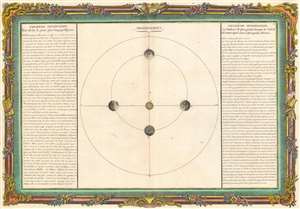
[L'Été est plus long que l'Hyver.]
$275.00
Acquire
- Digital Map Information
- Suitable for large format printing
- DPI: 600
- File Size: 41.86 MB
- File Type: ZIP / TIFF
- ICC color profile embedded
- Delivered instantly via download link
This is a 1761 Claude Buy de Mornas celestial map of the Earth's seasons. Using this orbit diagram, Buy de Mornas explains such concepts as why summer is longer than winter. He illustrates the Earth's elliptical orbit, exchanges how it changes in speed, which causes one part of the orbit (a season) to take longer than the other. He also effectively illustrates how the Earth's tilt with respect to the Sun effects the seasons, although he does not include this detail in the discussion of the seasons to the left of the diagram. To the right, Buy de Mornas discusses heat retention and how the changes daylight certain parts of the Earth receive during different parts of the year results in the temperature changes. (more details)