
Habermann, Franz Xaver

Franz Xaver Habermann (1721-1796) was a German engraver and artist active in the second half of the 18th century. Habermann was based in Augsburg where he was a well-respected engraver of urban views, particularly "vues d'optique" a type of lantern view rendered in reverse with the intention that it be viewed through an optic device. He is particularly known for his views of American cities, most specifically New York and Boston, which though merely artists conceptions and highly fictive, do illustrate the common European perception of the English colonies at the outset of the American Revolutionary War. Habermann's name occasionally appears in its French variant, "Francois Xav. Habermann" or more simplistically as "F. X. Haberman".
Important Revolutionary War view of the Great New York Fire of 1776.
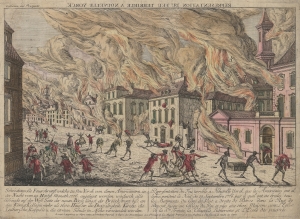
Representation du Feu Terrible a Nouvelle Yorck.
$900.00
Acquire
- Digital Map Information
- Suitable for large format printing
- Full resolution TIFF file
- ICC color profile embedded
- Delivered instantly via download link
A remarkable 1776 Franz Habermann vue d'optique or Lantern Print offering a European artist's conception of the Great New York Fire of 1776. The view depicts parts of downtown New York, near Broadway, the original Stock Exchange, the original Kings College, and Trinity Church, fully engulfed in flames. British soldiers, dressed in their signature red coats are savagely beating the city's panicked inhabitants while African slaves take advantage of the opportunity to loot the blazing buildings. (more details)
Revolutionaries Pull Down the Statue of George III, as Imagined by a Monarchist.
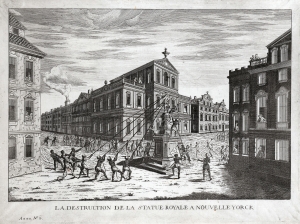
La Destruction de la Statue Royale a Nouvelle Yorck.
$900.00
Acquire
- Digital Map Information
- Suitable for large format printing
- Full resolution TIFF file
- ICC color profile embedded
- Delivered instantly via download link
This is Franz Xaver Habermann's engraving, showing his conception of the unrest gripping the city of New York following the reading of the Declaration of Independence on July 9, 1776 and the onset of the American Revolutionary War (1775 - 1783). The view refers to a historical event: The reading of the Declaration so emboldened the patriotic crowd that they tore down the statue of King George III, decapitated it, broke it into pieces - and shipped the remains to Connecticut, where the 4000 pounds of lead were melted down to cast 40,000 bullets, to be used against the British. (The head was set on a pike outside of Moore’s Tavern near Fort Washington, but was rescued by loyalists - including British officer, military engineer and mapmaker John Montresor - and eventually sent back to England.) New Yorkers never did like the statue: in 1773 an anti-graffiti, anti-desecration law was enacted in the city expressly to protect the statue from the abuse it regularly received. (more details)