
Hoefnagel, Joris
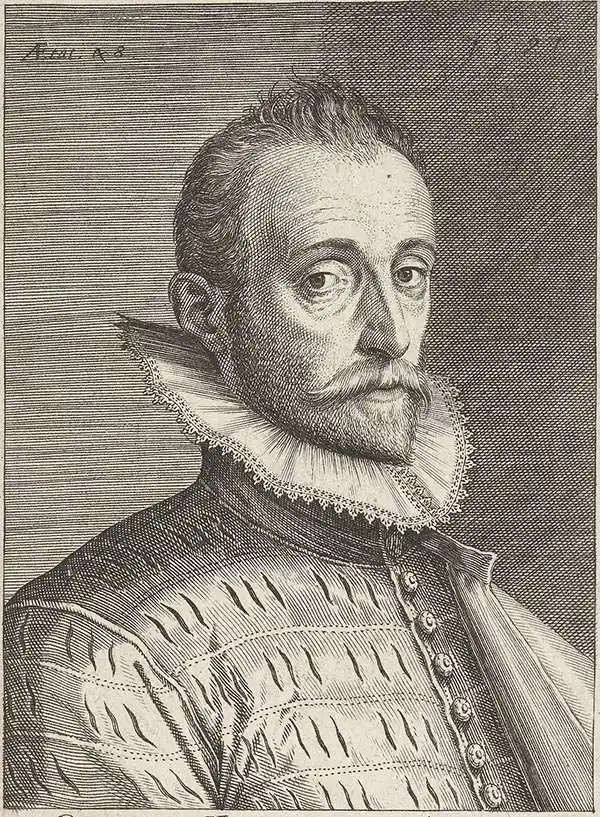
Joris Hoefnagel or Georg Hoefnagel (1542 - July 24, 1601) was a Flemish painter, printmaker, miniaturist, draftsman and merchant. A prolific illustrator, he was noted for his works of natural history and topography. He was the last notable manuscript illuminator; his designs were influential in the development of still-life painting as a genre. He was the son of a dealer in diamonds and luxuries, was given a broad humanistic education, commanded several languages, and could play various musical instruments. Although it is not documented, it is believed he received his training in painting from Hans Bol in Antwerp. He attended the universities of Bourges and Orléans, but the turmoil of the first French War of Religion forced him to flee back to Antwerp in 1563. His family business then sent him to Spain and England, though he would return frequently to Antwerp until the 1576 sack of the city during the Eighty Years War uprooted him. His travels thereafter took him to the Rhineland, Venice, and Rome. He visited ancient sites in the Kingdom of Naples. He produced an array of views and landscapes capturing the places he visited firsthand; more than a few of these would be committed to print by Braun and Hogenberg in their Civitates Orbis Terrarum, on which Hoefnagel worked for most of his adult life. He is known to have provided Ortelius with at least one map, depicting Cadiz and its environs. His skills developed, and he would be recommended to Albert V Duke of Bavaria as court painter. In spite of offers to serve the Cardinal Alessandro Farnese, he moved to Munich and painted for Albert for eight years. The position granted him great freedom to choose his own subjects of work, and to accept commissions broadly. In addition to producing his own work, he sold and collected old master drawings. Religious conflict forced him, a Calvinist, to leave Munich in 1591. He then went to work for Emperor Rudolf II, first residing in the city of Frankfurt am Main, and that vibrant trade center gave him access to a circle of Flemish humanists, such as Carolus Clusius, who would influence his later botanical illustrations. In 1594, he was yet again forced to leave because of his Calvinist faith, working his final years in Vienna and Prague. He died in Vienna.
Antwerp pictured prior to the Spanish Fury.
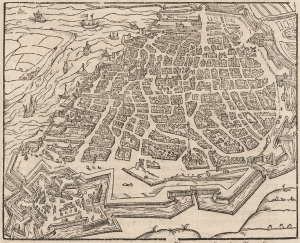
[Bird's-Eye View of Antwerp.]
$300.00
Acquire
- Digital Map Information
- Suitable for large format printing
- DPI: 600
- File Size: 16.38 MB
- File Type: ZIP / TIFF
- ICC color profile embedded
- Delivered instantly via download link
This detailed bird's-eye view of Antwerp is among the earliest printed images of the city. This woodcut first appeared in the 1574 German edition of Sebastian Münster's Cosmographia. It is a careful miniature of the 1572 view printed in Cologne by Braun and Hogenberg, the first of two views of that city appearing in their Civitates Orbis Terrarum. Both were drawn by Joris Hoefnagel, who was a native of the city, here shown on the River Schelde as it stood in the first part of the Eighty Years’ War (1568 - 1648). While it was at the heart of the Dutch Revolt, it was also the seat of Spanish power in the Low Countries. This is evidenced by the fort, built by the Grand Duke of Alba, commanding the southern approaches to the city. Within Antwerp's city walls are the Cathedral, town hall, Grote Markt, and fish market. The portrait below the view is Fernando Álvarez de Toledo y Pimentel, 3rd Duke of Alba (1507 – 1582), known as the Grand Duke of Alba whose bloody but ultimately futile repression failed to suppress the Dutch Revolt. (In 1576, two years after the first appearance of this view, Spanish forces visited the Spanish Fury on the city in the infamous Sack of Antwerp, then the greatest massacre in the history of the Low Countries.) The text describes the great statue of himself that the Grand Duke had erected in his new fortress, including the text of the statue's plaque, both in Latin and German. The spear-carrying statue can be seen in the middle of the fort. Following the sack of the city by the Spanish in 1576, Antwerp's citizens destroyed the statue. (It is conspicuously absent in Hoefnagel's 1596 view). (more details)
Drawn firsthand by Joris Hoefnagel
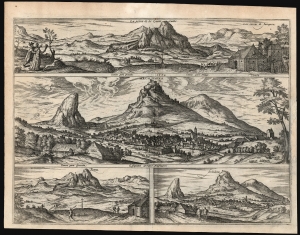
La Penna de los Enamorados. / Archidona. / Penna. / Archidona.
$750.00
Acquire
- Digital Map Information
- Suitable for large format printing
- Full resolution TIFF file
- ICC color profile embedded
- Delivered instantly via download link
These are Joris Hoefnagel's depictions of the Andalusian town of Archidona, and the distinctive peak of La Peña de los Enamorados dominating it, included in the 1596 fifth volume of Georg Braun and Franz Hogenberg's Civitatis Orbis Terrarum, the first published collection of city plans and views. (more details)
Hoefnagel's Eyewitness Views of Venice.
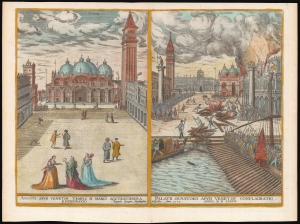
Augusti apud Venetos Templi D. Marci Accuratissima Effiguratio/ Palatii Senatorii Apud Venetos Conflagratio.
$1,100.00
Acquire
- Digital Map Information
- Suitable for large format printing
- Full resolution TIFF file
- ICC color profile embedded
- Delivered instantly via download link
These are Joris Hoefnagel's depictions of Saint Mark's Square in Venice, included in the fifth volume of Georg Braun and Franz Hogenberg's Civitatis Orbis Terrarum, the first published collection of city plans and views. (more details)