
Leo Africanus, Johannes

Johannes Leo Africanus, born al-Hasan Muhammad al-Wazzan al-Fasi, الحسن محمد الوزان الفاسي)(c. 1494 – c. 1554) was a Berber Andalusi diplomat and author who is best known for his 1526 book Cosmographia et geographia de Affrica, later published by Giovanni Battista Ramusio as Descrittione dell’Africa (Description of Africa) in 1550, the 16th century's most authoritative text on the geography of the north parts of Africa. He was born al-Hasan Muhammad al-Wazzan al-Fasin in Granada around the year 1494; his family moved to Fez soon after. There studied at the University of al-Qarawiyyin; As a young man he accompanied an uncle on a diplomatic mission, reaching as far as the city of Timbuktu in the Songhai Empire. 1517 found him working as a diplomat in the service of the Sultan of Fez, on a mission to Constantinople. He was a witness to the Ottoman conquest of Egypt. His return to Tunis in 1518 would be interrupted by his capture by Spanish pirates, and his imprisonment on Rhodes. His erudition saved him from a lifetime as a galley slave: An example for the ages of the value of an education, he was instead sent to Rome and presented to Pope Leo X. He was not only freed, but also given a pension as an inducement to remain in Rome. There he converted to Catholicism, and was in 1520 baptized with the Latin name Johannes Leo de Medicis. Following the death of his patron Leo X in 1521 Leo Africanus traveled Italy four years, and wrote: his works included an Arabic-Hebrew-Latin medical vocabulary, and an Arabic grammar. He returned to Rome in 1526, where he would write his African geography: although it is unlikely that he had firsthand knowledge of every place he described, he certainly would have been in a position to share knowledge of other travelers, and his access to the great library of Timbuktu may have availed him of much knowledge otherwise beyond reach.
Africanus' African geography would remain in manuscript until it was committed to print in Giovanni Battista Ramusio's Voyages as Della descrittione dell’Africa et delle cose notabili che ivi sono, per Giovan Lioni Africano. It would be reprinted five times, and later be published in other languages.
Leo Africanus' life following the completion of his Geography is uncertain. He may have remained in Rome until his death; he may have eluded the 1527 Sack of Rome, returning to Tunis until his death there. Another theory sends him from Tunis back to Morocco, where he still had relatives. Despite his intentions to do so (expressed in the text of his Africa book) Leo Africanus produced no further books that have survived.
Africanus' African geography would remain in manuscript until it was committed to print in Giovanni Battista Ramusio's Voyages as Della descrittione dell’Africa et delle cose notabili che ivi sono, per Giovan Lioni Africano. It would be reprinted five times, and later be published in other languages.
Leo Africanus' life following the completion of his Geography is uncertain. He may have remained in Rome until his death; he may have eluded the 1527 Sack of Rome, returning to Tunis until his death there. Another theory sends him from Tunis back to Morocco, where he still had relatives. Despite his intentions to do so (expressed in the text of his Africa book) Leo Africanus produced no further books that have survived.
Best 16th century map of the region around Marrakesh.
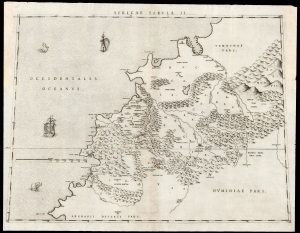
Africae Tabula II.
$2,000.00
Acquire
- Digital Map Information
- Suitable for large format printing
- DPI: 600
- File Size: 44.36 MB
- File Type: ZIP / TIFF
- ICC color profile embedded
- Delivered instantly via download link
This is Livio Sanuto's rare and beautiful 1588 map of central Morocco, focusing on Marrakesh and the area lying between the Oum Er-Rbia and the Sous Rivers. The map depicts the rugged western end of the Atlas Mountains with details drawn almost exclusively from the reports of the Berber-Andalusi traveler, diplomat, and author Johannes Leo Africanus (1494 - 1554). It is moreover a strikingly beautiful engraving, a masterwork of Livio's brother Giulio, who engraved all twelve of the maps comprising their atlas of Africa. (more details)