
Peiyang Press (北洋印字館)

Peiyang Press (北洋印字館; fl. c. 1925 – 1949) was a publisher active in Tianjin and Beijing (Beiping or Peiping at the time) before and during World War II (1939 - 1945). The press focused on books and maps for the Western traveler in China, including works in English, German, and Dutch. The company's logo included portraits of Gutenberg and Senefelder (who invented lithography). While its owners were likely Western, the staff was multinational; a 1925 directory notes a likely German manager surnamed Kleeman with both German (Niedernhofer, Kirn) and Chinese (Wang, Chi) names among the employees. Among their publications were British authors Alice Leighton Cleather and Basil Crump’s English-language book Buddhism: The Science of Life (2nd ed., 1928), Robert M. Duncan’s Peiping Municipality and the Diplomatic Quarter (1933), a Chinese-Dutch dictionary (1935) and a 1937 album of black and white photographs of British military exercises in China. They also issued a detailed city plan, Map of Tientsin, with editions published in at least 1928 and 1941. They are known to have published at least two influential pictorial maps in English during the 1930s, Frank Dorn's iconic A Map and History of Peiping and John Kirk Sewall's A Pictorial Map of Peiping.
AKA: 北洋印字館
Beijing's port: Foreign Concessions and 'Special Areas'.
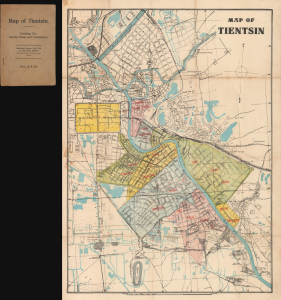
Map of Tientsin.
$1,200.00
Acquire
- Digital Map Information
- Suitable for large format printing
- Full resolution TIFF file
- ICC color profile embedded
- Delivered instantly via download link
This is a 1928 Chinese-issued Peiyang Press city plan or map of Tientsin (天津, Tianjin), China, at the start of the Nanjing Decade (1927 - 1937) of the Republican Era (1912 - 1949). This marked the last phase of the Treaty Port Era, which had predominated since the First Opium War (1839 - 1842), and was finally put to rest with the Second Sino-Japanese War/World War II. (more details)