
Xinxue Huishe (新學會社, New Learning Society)
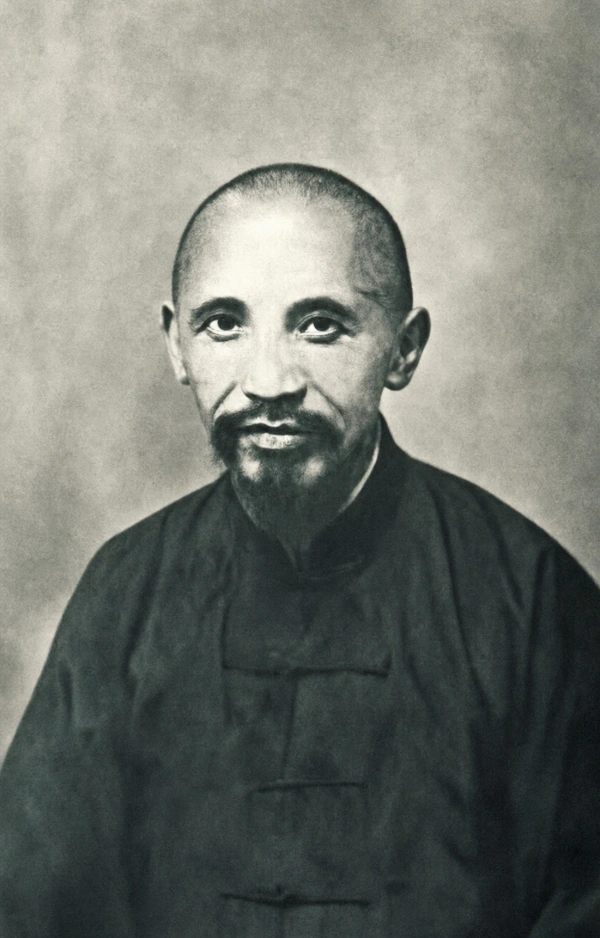
Sun Biaoqing (孙表卿, 1870 - 1967)
Xinxue Huishe (新學會社, New Learning Society; 1902 - c. 1948) was a Chinese printer and publisher active from the late Qing period (1644 - 1911) until the late Republican era (1912 - 1949). The firm was founded in Ningbo in 1902 by Sun Biaoqing (孙表卿, 1870 - 1967), a gifted local scholar who had passed the provincial-level imperial exams (achieving the coveted title of juren) and helped to compile the Fenghua County Gazetteer (奉化縣志). Xinxue Huishe was the first modern bookshop and publishing institution founded by Chinese people (rather than foreigners, such as missionaries) in Ningbo. It was founded to cultivate a new generation of Chinese intellectuals who could save China from its unfavorable situation in the early 20th century, and it sold mainly reference works and translations of foreign books. Still, the firm was rapidly losing money, and in 1903 Sun primarily relocated it to Shanghai (maintaining a small shop in Ningbo), receiving an infusion of capital from his friend and major salt merchant Li Xiacheng (李霞城, Sun's own family had been prominent salt merchants in the Ningbo area). Sun settled the business at No. 23 Qipan St. (棋盤街, now Henan Middle Rd. 河南中路, near Jiaotong Road 交通路, now Zhaotong Rd. 昭通路), an area of the International Settlement known for housing publishers and booksellers. Soon afterward, he invited another Ningbo scholar and associate, Zhuang Songfu (庄崧甫, 1860 - 1940), to manage the business's Shanghai location. Zhuang was an expert in agriculture, sericulture, and forestry, and a prominent supporter of the Xinhai Revolution in Shanghai and his native Zhejiang; he later served in several roles in the Republic of China government and represented local, provincial, and national assemblies. Once in Shanghai, the firm flourished, breaking away from the traditional book-selling model and inviting students, especially those who had studied in Japan, to translate new Japanese textbooks and academic works. In the following years, the firm opened additional locations in Beijing, Hankou, Guangzhou, Jinan, and Tianjin (which became centers for organizing anti-Qing revolutionary activities in 1911, including serving as weapons caches for the revolutionaries). Like Zhuang, Sun Biaoqing also was engaged in business and public service after the Xinhai Revolution, likely leaving much of the day-to-day operation of the firm to subordinates; his other pursuits included teaching as a professor at Shanghai University, serving as director of the Ningbo Cotton Exchange, and managing the Ningbo newspaper Siming Daily (四明日报). Xinxue Huishe published on a wide range of topics, including Chinese religion, culture, and foodways; practical guides for farmers and businesspeople; and information relevant to Shanghai's cosmopolitan context, such as dictionaries of foreign terms and placenames. They are known to have published at least five maps: a 1912 map of Ningbo, a map of Hankow (Hankou) from the early Republican era, an influential world map (二十世紀中外大地圖, in at least two editions), a transportation and communication map of China (中國交通全圖) in 1923, and a very long (144 inches) foldout map of the Yangzi (Yangtse) River between Mao County, near Chengdu, and the mouth of the river near Shanghai, published in 1922. As with nearly all Chinese publishers, the firm's productivity dropped substantially after the start of full-scale war with Japan in 1937, and its last publication seems to have appeared in 1943, with a single 1948 publication likely a reissue of an earlier work. After the Second World War and the Communist Revolution, Sun Biaoqing stayed in mainland China, serving on the Ningbo Municipal Committee and Zhejiang Provincial Committee of the Chinese People's Political Consultative Conference, as well as a member of the Revolutionary Committee of the Chinese Kuomintang (a Communist-affiliated breakaway of the KMT opposed to Chiang Kai-Shek).
AKA: 新學會社, New Learning Society
Hankou in the Early Republican Era.
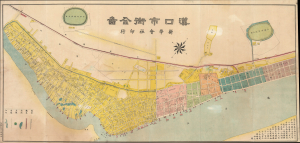
漢口市街全圖 / [Complete Street Map of Hankou].
$1,200.00
Acquire
- Digital Map Information
- Suitable for large format printing
- Full resolution TIFF file
- ICC color profile embedded
- Delivered instantly via download link
This is a rare, large-format c. 1912 city map or plan of Hankou (Hankow), China, now part of Wuhan, printed and published by Xinxue Huishe. It presents the city in the early Republican era, following the revolution (which began in nearby Wuchang) that toppled the Qing Dynasty. This was a transitional period for China in many ways, retaining many legacies of the Qing era, including the numerically small but economically and culturally significant presence of foreigners in foreign concessions at Hankou and other cities, but also looking forward to potential future paths of cultural, economic, and political development. (more details)