
1858 Gillette Case Map of Dutchess County, New York, Hudson River Valley


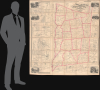
Map of Dutchess Co. New York from Actual Surveys.
Estates of New York's 'Aristocracy'.
- Digital Map Information
- Suitable for large format printing
- DPI: 600
- File Size: 205.94 MB
- File Type: ZIP / TIFF
- ICC color profile embedded
- Delivered instantly via download link
Estates of New York's 'Aristocracy'.
This is John Gillette's 1858 very large-format case map of Dutchess County, New York. It is notable, among other features, for including the estates of the leading families of New York, including the father and grandfather of future president Franklin D. Roosevelt.A Closer Look
This immense map (5' x 5') covers the county with town lines and individual property owners noted, including some of the wealthiest and most prominent families in New York's history, such as Stuyvesant, Vanderbilt, Roosevelt, Livingston, Van Wyck, and Verplank. County and town names are indicated throughout, as are roads, waterways, railways (Hudson River Railroad and Harlem Railroad), schools, churches, workshops, mills, orchards, landings, and lighthouses along the Hudson River, and other features. Some 50 insets appear around the main map, providing a closer view of individual towns and villages, ranging from Poughkeepsie, the county's largest town, to small crossroads settlements home to a handful of landowners. A table of distances, several local business directories, and 6 views of prominent buildings (mostly residences) also appear in the margins of the map.'Rosevelt' Estate in Hyde Park
At left-center, in the southern portion of Hyde Park, are the properties of 'Dr. Rosevelt' (Isaac Daniel Roosevelt; 1790 - 1863), and 'J. Rosevelt' (James Roosevelt I; 1828 - 1900), the grandfather and father, respectively, of future President Franklin Delano Roosevelt (1882 - 1945); the latter property includes the home the president was born and raised in, now a National Historic Site, and his presidential library.Lands of Matthew Vassar
Although the college, initially a women's college, was not founded until a few years later in 1861, the location of Vassar College can be seen here southeast of the main part of Poughkeepsie, at the property marked 'M. Vassar.' Businessman Matthew Vassar (1792-1868) donated half of his fortune (more than $10 million in today's dollars) and 200 acres at the site noted here to establish the college.Historical Context
In the decades after the American Revolutionary War (1775 - 1783), and especially following the 1825 completion of the Erie Canal, the population of the Hudson Valley grew rapidly, and the area's economy underwent the early stages of industrialization. Dutchess County was also known as a thriving agricultural region renowned for its beautiful farmland, particularly for the production of wheat, corn, and oats. The county seat of Poughkeepsie was a hub of trade and commerce, with a bustling waterfront. The Hudson (River) Railroad reached Poughkeepsie in 1849, providing improved transportation and commercial opportunities. A year later, it extended to Albany, transforming Poughkeepsie from a river town into a railroad hub, the heart of a network that expanded in subsequent decades.Publication History and Census
This map was prepared by Chas. Bachman and G. H. Corey, published in Philadelphia by John E. Gillette, and copyrighted to Robert Pearsall Smith in 1858. It was likely strongly influenced by James C. Sidney's 1850 wall map of Dutchess County (also offered by us, DuchessCountyNY-sidney-1850), which Gillette and Smith also published. The present map is larger and contains considerably more information with the dozens of insets and directories.This map is noted among the holdings of the Library of Congress, New York Public Library (not in the online catalog but in the printed 'Dictionary Catalog of the Map Division'), the Boston Public Library, Yale University, Cornell University, the University of Chicago, and the University of Wisconsin-Milwaukee.
Cartographers
John Edward Gillette (1828 - March 10, 1911) was an American map publisher. Gillette published several county maps of New York as well as a map of the vicinity of Philadelphia. Gillette died in Hudson, New York. Per his obituary, Gillette 'is best remembered as the organizer of the American Paper Car Wheel Company, whose process of making wheels of pressed paper was successful from the start'. Further Details...
Robert Pearsall Smith (February 1, 1827 - April 17, 1898) was an American map maker active in Philadelphia from the middle to late 19th century. Smith was born to a Quaker family in Philadelphia, all librarians and publishers. Robert Pearsall originally ran a law bookstore at 19 James Street, Philadelphia. It was not until 1846 that Smith began producing maps in collaboration with this father, John Jay Smith (1798 - 1881), and brother, Lloyd P. Smith (1822 - 1886). One year earlier, in 1845, John Jay, then librarian at the Library Company of Philadelphia and Loganian Library, acquired the American rights to the anastatic process of transfer lithography. In February of 1846 he and his two sons founded the Anastatic Office, a printing concern based on the anastatic process located at 317 Market Street, Philadelphia. The Anastatic Office produced numerous copies and reissues of historic documents and maps from the Library Company's collection before being dissolved in 1847. In the same year Robert Pearsall opened a printing establishment under his own name at 144 Chestnut Street. In 1858, he joined forced with the Swiss-American engraver Frederick Bourquin (1808 - 1897) under the imprint 'F. Bourquin and Company' (602 Chestnut Street). Smith retired suddenly and inexplicably from the printing business around 1865. Smith was also deeply religious, a lay leader in the Holiness Movement in the United States and the Higher Life Movement in Great Britain. In 1873, Smith and his wife, Hannah Tatum Whitall (1832 - 1911), crossed the Atlantic to preach in England, Germany and Switzerland. They returned in 1875, preaching in Brighton, where Smith supposedly had an affair with an American writer. In, 1888, his entire family moved to England. Further Details...
Condition
Very good. On original linen. Some minor toning.
References
Library of Congress, G3803.D8G46 1858.B3. OCLC 55136108.