
1946 Dix Lawrence Pictorial Folklore Music Map of the United States

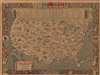
Folklore Music Map of the United States.
Visual celebration of American folk music.
- Digital Map Information
- Suitable for large format printing
- File Size: 43.67 MB
- File Type: ZIP / TIFF
- ICC color profile embedded
- Delivered instantly via download link
Visual celebration of American folk music.
This is a 1946 Dorothea Dix Lawrence and Harry Cimino pictorial folklore music map of the United States. The map is a visual celebration of American folk music. It was compiled by opera singer turned folklorist Dorothea Dix Lawrence from her 'Primer of American Music' radio program. The map is part of her efforts to broadly collect and disseminate music in America.A Closer Look
Over ninety songs are referenced, with pictorial vignettes, music staffs with notes, and oversized music notes labeling individual songs. Some vignettes illustrate specific scenes, while others present a song's overall aesthetic. A key near the top border identifies songs by their 'musical classification,' which includes French songs, miners' songs, fishermen's songs, ballads, and cowboy songs. The pictorial border contains musical instruments, a few more folk songs, and illustrations of Zuni symbols representing musical notes. The key also includes a detailed explanation of the border illustrations.Publication History and Census
This map was created by Dorothea Dix Lawrence and illustrated by Harry Cimino in 1946. It was printed and published by Hagstrom in New York. We note 19 examples cataloged in OCLC.Cartographers
Dorothea Dix Lawrence (September 22, 1899 - May 23, 1979) was an American soprano and folklorist. Born in New York City, she attended Barnard College for a while where she studied voice. Her operatic debut happened in 1929 in Montreal with the Quebec Opera Company, and her career blossomed during the 1930s and 1940s, performing regularly throughout the United States and Europe. She also performed on television and radio broadcasts. Lawrence's passion for American folklore and folk music developed during the 1930s and she began collecting songs, including those from the Zuni Indians in New Mexico and residents of the Pine Barrens on New Jersey. She created a radio program called Primer of American Music in 1939, which was sponsored by the Philadelphia Board of Education and consisted of twenty-seven weekly broadcasts. She also produced and starred in an eight-week program entitled Folk Musicians for WNYC. This interest led to the creation of the Folklore Music Map of the United States in 1945, which was widely distributed to American schools. The map became the basis for Lawrence's hundreds of recitals and lectures of American music across North America and Europe. She retired in 1970 and died in Plainfield, New Jersey on May 23, 1979. Further Details...
Harry Cimino (1898 - 1969) was an American woodcut artist, illustrator, and engraver. Cimino collaborated with Dorothea Dix Lawrence (1899 - 1979) on her Folklore Music Map of America. He was born in Marion, Indiana, and died in Sharon, Connecticut. Further Details...
Andrew Gunnar Hagstrom (1890 - September 24, 1977) was a map publisher based in Maspeth, Queens. Hagstrom was born in Karleby, Skaraborg, Sweden. He emigrated to New York in 1909, where he took work milking cows at a farm near Coney Island, Brooklyn. He then worked in the meatpacking industry while taking a degree in commercial art at the New York Mechanics Institute. Afterward, he founded a drafting business in Manhattan and created a map to showcase his drafting skill and help customers find his shop. Around 1916, he purchased the copyrights to Dolph & Street Company's base maps of New York City. His maps proved popular, and he expanded operations by founding the Hagstrom Map Company (1916 - 1968) and issuing additional maps of parts of New York City and the surrounding regions. By 1949, Hagstrom had issued more than 150 maps, guides, and atlases, most of which focused on New York. Many of his maps from this period feature a unique dating cipher based on his name (HAGSTROMCX corresponds to the numbers 1-9, with 0 representing the months and years; for example, a map with the code OSO would be 7/47, or July 1947). Hagstrom pioneered a cartographic style that exaggerated street widths to improve clarity and make room for large-print, readable labels. The New York Subway system even hired Hagstrom to produce its map, which was in use from the 1940s to 1958. In 1958, the King of Sweden knighted Hagstrom (Royal Order of Vasa, First Class) for his success in the United States. His company flourished until 1968, when Macmillan acquired it. The brand has since passed through multiple corporate portfolios and is now owned by Kappa Publishing Group. Hagstrom died in 1977 at age 81 in the Virgin Islands. Further Details...
Condition
Very good. Laid down on archival tissue.
References
Rumsey 7863.000. OCLC 9239789.