
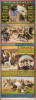
1915 Metropolitan Printing Co. Promotional Broadside for Tompkins Wild West Show

Real Wild West...
Romanticizing the Frontier, Entertaining the Masses
- Digital Map Information
- Suitable for large format printing
- File Size: 81.37 MB
- File Type: ZIP / TIFF
- ICC color profile embedded
- Delivered instantly via download link
Romanticizing the Frontier, Entertaining the Masses
This is a stunning c. 1915 chromolithograph promotional broadside for 'Tompkins' Real Wild West' show, produced by the Metropolitan Printing Company. In the spirit of Buffalo Bill, Tompkins' show was among the most acclaimed Wild West shows of its time, touring the United States and Europe regularly in the early 20th century.A Closer Look
The sheet is roughly divided into four sections, highlighting various aspects of the show. The top section provides an overview of the show's '30 famous features' involving 550 people and horses, including sporting events, mock bull ring battles, equestrian jumps, a cattle round-up, and cavalry charges. Some of the concepts and terminology were common to other Wild West shows, including Buffalo Bill's, such as the employment of Russian Cossacks and 'the Cheyenne Champion' (greeted here by Teddy Roosevelt, based on a somewhat famous contemporary photograph of a meeting during a stopover during his 1912 'Bull Moose' presidential campaign). The appearance of swastikas here is confusing if not jarring at first glance, but the symbol (no doubt little understood by its audience) was widely used in advertising at the time and considered a symbol of good luck.The second section depicts the bull ring portion of the show, recreating a deadly 'fight for life between the cowboy demon and an enraged bull' 'in all its historic realism.' The third section contains two illustrations: at left, a depiction of Siberian Cossacks, who engaged in a 'rough riding' competition with cowboys, and at right, general promotional text and information, including showtimes. At the bottom is a representation of 'equestrian football,' a combination of polo and football using a gigantic hide ball, with teams composed of cowboys/cowgirls and Indians.
Tompkins' Real Wild West
In the early 20th century, Wild West shows stood at a crossroads between nostalgia for the frontier and the growing world of modern mass entertainment. Originating in the late 19th century with figures like Buffalo Bill Cody, these shows blended rodeo skills, staged battles, sharpshooting, trick riding, and dramatic depictions of conflict between white settlers and Native Americans. By the 1900s and 1910s, as the American frontier was increasingly viewed as a closed chapter in national history, Wild West shows evolved to satisfy ongoing public interest. They incorporated more theatrical elements, international tours, and collaborations with circuses, allowing them to survive against rising competition from vaudeville, motion pictures, and later radio. Many performers who had grown up in the era of the real cattle drives and frontier conflicts found a place on these traveling stages, turning lived experience into entertainment for audiences captivated by a romanticized version of the Old West.Charles Tompkins (1873 - 1957) was a Texas-born roper and rider who became a noted Wild West performer associated with Cooper-Whitby's circus. Tompkins was raised as a ranch hand in Texas before going into show business and was known for his expert horsemanship and roping skills. He joined Buffalo Bill's Wild West Show, where he met his future wife and business partner, the acclaimed equestrian performer Mabel Hackney (1878 - 1950). The couple toured Europe with McCaddon's Great International Circus in 1905 before launching their own show, which in 1912 was rebilled Tompkins' Real Wild West, which became a feature attraction of 'Cooper and Whitby's European Circus.' In the mid-1910s, the show successfully toured the eastern United States, but it was shut down in 1917 when much of the cast was drafted for the First World War. Afterward, the Tompkins moved to Oklahoma and opened a car dealership, but remained involved in entertainment through rodeos and the state fair. The Tompkins' careers reflect the transitional nature of Wild West entertainment during the early 20th century, shifting from grand, standalone spectacles like Buffalo Bill's toward integrated circus attractions that preserved elements of frontier legend even as American popular culture shifted into new forms.
Chromolithography
Chromolithography, sometimes called oleography, is a color lithographic technique developed in the mid-19th century. The process involved using multiple lithographic stones, one for each color, to yield a rich composite effect. Oftentimes, the process would start with a black basecoat upon which subsequent colors were layered. Some chromolithographs used 30 or more separate lithographic stones to achieve the desired product. Chromolithograph color could also be effectively blended for even more dramatic results. The process became extremely popular in the late 19th and early 20th centuries when it emerged as the dominant method of color printing. The vivid color chromolithography produced made it exceptionally effective for advertising and propaganda imagery.Publication History and Census
This broadside was printed by the Metropolitan Printing Company of New York City. It is undated but from context (the history of the Tompkins Real Wild West and the mention of 'ex-President Roosevelt') likely dates to the mid-1910s. As an ephemeral promotional piece, it is unlikely that many of these posters would have survived, and indeed, we have been unable to locate any other examples of this work in institutional collections or on the market.Cartographer
The Metropolitan Printing Company (c. 1875 - 1919) was a New York city-based chromolithographic printer of posters and handbill advertisement for theater, film, and other forms of entertainment. It should be distinguished from other companies of the same name that existed in Chicago, Ann Arbor, Portland, Oregon, and Edmonton, Canada. The company began by publishing librettos for operas before moving on to promotional pieces (posters) for operas, then other stage acts like modern musicals, and finally motion pictures. It also occasionally printed pieces for political campaigns and conventions. Further Details...
Condition
Very good. Laid down on linen. Upper border added in facsimile.