
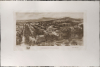
1907 Rummell Bird's-Eye View of the University of Virginia

This item has been sold.
University of Virginia.
Archetype of American Universities
- Digital Map Information
- Suitable for large format printing
- File Size: 2585.82 MB
- File Type: ZIP / TIFF
- ICC color profile embedded
- Delivered instantly via download link
Archetype of American Universities
This is a scarce 1907 view of the campus of the University of Virginia in Charlottesville, signed by the artist Richard Rummell. It captures the university's campus soon after the reconstruction of its famous Rotunda (badly damaged in a 1895 fire) and the construction of several new buildings, the first major additions to the campus beyond Thomas Jefferson's original design.A Closer Look
This view is oriented towards the southwest, looking over the main quad ('Academical Village') of the university, which contains most of the oldest buildings on campus, with the Blue Ridge Mountains in the background. The oldest building, however, is not in the Academical Village but just behind it, at top-center here, the Monroe Hill House complex, so named because the university was built on land once owned by James Monroe.The Academical Village itself was designed by Thomas Jefferson and reflected his Enlightenment ideals, with its logical, geometric design. Professors and students were intended to live and learn in close proximity around a terraced lawn framed by pavilions designed to reflect different areas of study in their very architecture. The largest building at the head of the Lawn is a domed Rotunda, a half-scale model of the Roman Pantheon (a secular building, rather than a church, as was the standard lodestar on other campuses). Behind the pavilions are another row of buildings, 'the Range,' which have served a variety of functions over the university's history.
Despite its august origins, the university had recently undergone a number of changes when this view was prepared. The original Rotunda was heavily damaged in a fire in 1895 and required significant reconstruction. The architect (Stanford White) and firm (McKim, Mead, and White) hired to rebuild the Rotunda also constructed new buildings to compensate for the loss of the Rotunda: Cabell Hall (now Old Cabell Hall), Cocke Hall, and Rouss Hall, opposite the Rotunda on the other side of the Lawn, the first major alterations of Jefferson's original design for the campus. The same year this view was produced, a statue of Homer made by sculptor Moses Jacob Ezekiel was placed before Cabell Hall, while three years later a statue of Thomas Jefferson by the same sculptor was installed in front of the Rotunda.
The University of Virginia
UVA was founded in 1819 by Thomas Jefferson, who envisioned it as a new kind of institution dedicated to the 'illimitable freedom of the human mind.' Unlike the religiously affiliated colleges of the early republic, Jefferson's university would be secular, emphasizing reason, science, and the liberal arts. Aside from Jefferson, former president James Madison, sitting president (when the university was founded) James Monroe, and sitting Chief Justice of the Supreme Court John Marshall were all deeply involved in the university's early history. When it opened in 1825, UVA offered an unprecedented range of elective courses and allowed students to shape their own programs of study, setting it apart from more rigid institutions of the time (which typically offered only three courses of study - medicine, law, and divinity). It quickly became a leading center of intellectual life in the South and helped pioneer new models of higher education, as well as a new type of architecture and campus design, in the United States.Rummell University Views
Rummell was an American landscape artist known for his drawings of American universities. In 1906, Rummell issued his first university view - an illustration of Yale. That view was a sepia tone photogravure copyrighted by F. D. Nichols of Boston and printed by A. W. Elson of Boston. A view of Harvard, likely Rummell's second view, also appeared in 1906 with the same Nicholson/Elson imprint. Subsequently, Littig and Company of New York commissioned Rummell to prepare watercolors of many of the nation's most prestigious colleges. From these watercolors, copperplates were engraved, and both photogravures and lithographs were issued. The photogravures tend to have a much lower survival rate than the lithographed images, which were printed on heavier paper.Most of Rummell's university views are strikingly similar in style, revealing the entire campus in panoramic splendor. The views are uniformly issued from an altitude of about 300 feet, suggesting that Rummell most likely worked from a balloon. In more recent times, many of the original lithographic plates for Rummell's college views have been rediscovered, leading to multiple modern reprints of the Littig editions, but the original lithograph printings and especially the photogravures, as here, have become extremely rare.
Publication History and Census
This photogravure was based on a painting by Richard Rummell and was procured by Elson of Boston, but the Elson imprint, which would have been in the lower-right, has been removed. Instead, what is visible here is a Littig imprint and the date 1907. The present example is signed by Rummell in pen in the lower right. Regardless of imprint, this view is quite rare, only being noted in institutional collections among the holdings of the University of Virginia itself.Cartographer
Richard W. Rummell (1848 – June 4, 1924) was an American artist active in Brooklyn during the late 19th and early 20th century. Rummell was born in Canada, the son of German immigrant Frank X. Rummell and his wife Eliza Rummell. He immigrated to the United States as a youth settling with his parents in Buffalo. He relocated to Brooklyn when he was in his mid-30s, setting up an illustration office at 258 Broadway in Manhattan. Rummell is best known for his series of views of American colleges completed around the turn of the century. Since Rummell's views universally appear to be drawn from an altitude of about 300 feet, it has been speculated by many art historians that he worked from a balloon. Rummell was also a bit of a futurist and among his more interesting works are a series of speculative images of the New York of tomorrow, with vast airships, trains running over the tops of skyscrapers, and elegant sky bridges. In the 1950s, the original printer's plates for many of Rummell's university views were rediscovered in a Brooklyn warehouse. Rummell's Brooklyn home was located at 45 Bay 28th Street and later 73 Hanson Place. In addition to his work as a visual artist, he was an accomplished actor and an avid yachtsman. He founding member of the Bensonhurst Yacht Club, where his yacht, the Careless was usually docked. He was also a member of the Royal Arcanum fraternal order. Rummell was survived by his wife, Emmeline Rummell, daughter, Chrissie Atkinson, and two sons, John Tribel Rummell, and Richard Rummell Jr., who became a famous Florida architect. Further Details...
Condition
Excellent. Warm overall toning. Deckled edges.
References
OCLC 647987162.