
1904-07 Wanamaker Postcard - Rare, Early New York City Subway Image

This item has been sold.
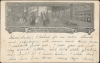
The Wanamaker Station in the Subway at Astor Place.
An Extremely Rare Early Subway Image.
- Digital Map Information
- Suitable for large format printing
- Full resolution TIFF file
- ICC color profile embedded
- Delivered instantly via download link
An Extremely Rare Early Subway Image.
This 1904-07 Wanamaker postcard presents one of the few known surviving examples of one of the first printed images of the New York City subway, specifically the platform of the Astor Place Station - which provided entry to the famed Wanamaker's department store. It was printed in 1904 by Wanamaker's to promote their expanded New York City location, whose underground entrance was touted as a unique modern convenience.A Closer Look
That busy subway platform is pictured here, showing fashionably dressed New Yorkers at the entrance to the Wanamaker's store. A train, with its taillight shining, can be seen leaving on the uptown track. Although Wanamaker's is long defunct, Kmart used the entrance until it closed in 2021.This image first appeared in print in 1904; we have seen only six examples of it. Two of these, this example included, were printed in postcard format. The four others were printed on a larger, folding Subway Guide, with a timetable and the first printed map of the nascent subway. The present postcard example bears a handwritten note, is addressed, and is postmarked November 3, AM, 1908.
Pictured on the card was the innovative, direct, station-level connection between Wanamaker's new Manhattan store and the newly-completed subway. Wanamaker's would vigorously promote the store, and this connection at Astor Place figured prominently in their advertising even before the store opened its doors in 1907: 'There is no rainy day dullness at WANAMAKER'S! Come by the subway and you don't need to go outdoors at all.' This is entirely in keeping with the company's history of advertising innovation. They were the first retailer to run half- and full-page newspaper advertisements regularly, and the first to employ a full-time copywriter. Most of their advertising was printed in-house. This image was printed and first distributed in 1904, the year the subway began operation, but three years before the Astor Place Wanamaker's opened. The Wanamaker's ads printed in the New York Times and the Tribune of April 11, 1905, announced,
Vest-Pocket Subway Guide Cards giving diagram of the Subway, list of stations, and running time of Express trains, will be mailed free, upon request. Mighty handy to have in the shopping-bag, or pocket, for reference.. It is not known whether the postcards were printed prior to, concurrently with, or after the Subway Guides. The Guides themselves appear to have been produced in a single print run, with hand-stamped updates after the store's 1907 opening. The postcards do not appear to have been produced in greater numbers.
The Letter
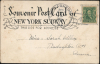
This postcard bears a stamp (Benjamin Franklin One Cent, 1902-1907) and was canceled the morning of November 3, 1908, at the post office of Tiadaghton, Pennsylvania. It is addressed to Miss Sarah Willcox of Tiadaghton, Pennsylvania: then a remote village in Delmar Township, Tioga County (Tiadaghton survives only in the name of a nearby State Forest, and the village has disappeared, its post office closed in 1936). The note reads:Dear Sadie: I looked for an order blank and catalogue over home and then here. I couldn't find one. I hope you are feeling much better. Will talk with you Friday night if I have time. I wish this line run over there… Good Bye BelleWe know something about Belle and Sadie: the 1908 directory for Delmar Township has been digitized. Sarah A. Wilcox (August 10, 1888 - May 1976) was a schoolteacher then living on her family's farm in Tiadaghton. Living on another family farm on the same route was her neighbor Lydia Belle Knowlton (1888 - 1970). Though the same age, Belle was listed as a student.
Why would a postcard be mailed to Tiadaghton from Tiadaghton? Belle seems to refer to a trip to Wanamaker's, and it seems she went to the city. But why the Tiadaghton postmark? November 3, 1908 was a Tuesday, and it is an AM postmark. We suspect that Belle took a day trip to the city on Monday, and that she took the train. She would have taken the Pine Creek line from Tiadaghton, and changed to the New York Central. From Grand Central Station, the subway was available to Astor Place. This would have been about two hours each way, so Belle's wistful wish was not idle: if the Lexington Avenue train ran all the way to central Pennsylvania, it would have shaved off a lot of time in transfers.
This might not just have been a shopping trip: an election was coming up on Tuesday, and on Monday Samuel Gompers delivered a speech in support of William Jennings Bryan's candidacy. The speech was at Grand Central Plaza, so she would have been in the neighborhood. Women's suffrage was still twelve years away, but both Gompers and Bryan were vocal advocates of the women's vote.
We know from the note that Sadie was sick: maybe she'd planned to go but had to beg off, asking her friend to pick up a catalog and order form from the famous department store? Failing that, Belle picked up a postcard. Rather than commit it to the post office in New York, she wrote her note - maybe on the train coming back Monday evening. Arriving at Tiadaghton station, she popped the card in the mailbox at the post office (which was the same location). When the post office opened the next morning, the card was collected, postmarked, and passed along to the postman for delivery that day. Sadie could look forward to a visit, or perhaps a phone call, from her friend the next Friday.
Publication History and Census
This card was printed by Wanamaker's - either in-house or by one of the job printers the firm used for advertising - as early as 1904. This image appeared in only a single print run with the map, and similarly, only a single run in postcard format. Once photographic imagery of the subway was available, Wanamaker's shifted their promotions to utilize it. We are aware of only three examples of the map to appear on the market with the c. 1907 red stamped note present; only a single example without the stamp (and postmarked 1904) has come to light. Until its reference in Augustyn and Cohen's 1997 work, this piece had evaded the attention of all literature relating to the mapping of New York. OCLC has no institutional copies of either state cataloged. The Durst Collection of Columbia University contains what appears to be an example of the image printed as a postcard, but they do not provide a verso image to confirm.Cartographer
John Wanamaker (July 11, 1838 - December 12, 1922) was an American merchant and public figure, and a pioneer in advertising and marketing. Born in Philadelphia, Pennsylvania, he would found the famous department stores that carried his name. Later in life he served as U.S. Postmaster General during the term of President Benjamin Harrison, (1889 - 1893.) He opened his first, Philadelphia store - Oak Hall - in 1861; his second store opened in 1869, and this one would be named John Wanamaker and Co.; in 1875, he moved the growing business into an abandoned railroad depot and converted it into what is considered the first department store in Philadelphia. The 12-story Grand Depot, with its Grand Court, pipe organ, iconic Eagle statue, and holiday light shows became an institution. In 1896 Wanamaker expanded into New York City, taking over space that had been established by A. T Stewart. He expanded again into an adjacent, newly-built 14-story edifice which Wanamaker cannily had built with its 32 acres of retail space directly accessible via the new Astor Place subway station. A proponent of the power of advertising, he was the first retailer to place half and later full-page newspaper advertisements, eventually hiring the world's first full-time copywriter to fuel his circulars. The arrival of Wanamaker's stores in New York was spearheaded with a vigorous newspaper campaign, including the clever innovation of producing the first subway map intended for use by its ridership. Further Details...
Condition
Very good. Some scuffing to corners and faint soiling, else excellent.
References
cf. Augustyn, R. T., Cohen, P., Manhattan in Maps 1527 - 1995 pp. 148-49.