
1895 Fee Chromolithograph Bird's-Eye View Map of Yellowstone National Park

Yellowstone National Park. Northern Pacific Railway.
Striking chromolithograph of Yellowstone!
- Digital Map Information
- Suitable for large format printing
- Full resolution TIFF file
- ICC color profile embedded
- Delivered instantly via download link
Striking chromolithograph of Yellowstone!
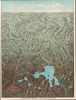
This is an 1895 chromolithograph bird's-eye view map of Yellowstone National Park, Wyoming, prepared by Charles S. Fee, the Passenger Traffic Manager at the Northern Pacific Railroad, and printed by Poole Bros. It reflects the deep connection between the park and the railroad, which provided the first direct and relatively fast (non-stagecoach) connection between Yellowstone and the eastern United States.A Closer Look
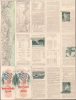
With Yellowstone Lake in the foreground, the view extends northward as far as Bozeman and Livingston, Montana. Impressive detail is included throughout, identifying mountains, plateaus, lakes, geyser basins, and hot springs. Yellowstone landmarks, such as Elephant Back, the Grand Canyon, and Old Faithful (in the Upper Geyser Basin), are labeled. The Lake Hotel, Fountain Hotel, Canon Hotel, and Mammoth Hot Springs Hotel all appear. The Yellowstone River snakes its way through the park and roads (colored white, so they stand out) wind their way from north to south. The Northern Pacific Railway runs across the top of the view and south from Livingston to Cinnabar, just outside Yellowstone.The verso contains promotional text and images about Yellowstone as well as for the Northern Pacific's steamship connection to Alaska by way of Tacoma and Puget Sound. An inset map displays the steamer connection as far north as Chilcat (the Chilkat Inlet). A smaller map covers the entire Northern Pacific system and its connections.
Yellowstone National Park
Yellowstone National Park, established by the U.S. Congress and signed into law by President Ulysses S. Grant on March 1, 1872, is America's first and most famous national park. The park occupies the northwestern corner of Wyoming but also includes parts of Montana and Idaho. Yellowstone is considered to be the world's first national park. Today a UNESCO World Heritage Site, the park is known for its incredible geothermal features, the most famous of which is the Old Faithful Geyser. Yellowstone's iconic geothermal activity is caused by a dormant supervolcano, the largest in North America, lying directly under the park. Yellowstone Lake, one of the largest high-elevation lakes on the continent, occupies the caldera's center. Yellowstone is also renowned for its wildlife, home to wolves, grizzly bear, elk, black bear, and America's largest wild bison herd. As one of the most popular National Parks in the United States, millions visit Yellowstone annually to experience its mud pots, geysers, wildlife, and striking scenery.The Northern Pacific Railroad
The Northern Pacific Railroad (initially called the Northern Pacific Railway) was a titan of the Gilded Age, chartered by Congress in 1864 with the ambitious goal of bridging the gap between the Great Lakes and the Pacific Northwest. However, the road to completion was anything but smooth. Led initially by financier Jay Cooke (1821 - 1905), the project became a victim of its own scale, helping trigger the Panic of 1873 and falling into bankruptcy before the tracks even reached the Montana Territory. It was only when Henry Villard (1835 - 1900) took the reins in the early 1880s that the project found its second wind. On September 8, 1883, the 'Gold Spike' was finally driven at Gold Creek, Montana, creating a continuous rail link that transformed the northern frontier from an isolated wilderness into a corridor of commerce, settlement, and industry.The Northern Pacific was instrumental in 'inventing' the American West as a tourist destination. Realizing that empty passenger cars were bad for the bottom line, the railroad's management heavily lobbied for the creation of Yellowstone National Park and subsequently became its primary gatekeeper. In 1883, the NP completed a crucial branch line from Livingston to Cinnabar, Montana, right at the park's northern doorstep. By marketing the region as 'Wonderland' through lavish advertising campaigns, the railway traded rugged stagecoach journeys for the luxury of Pullman cars. This partnership helped to establish a symbolic and physical connection between railroads and the American West that had endured down to the present.
Chromolithography
Chromolithography is a color lithographic technique developed in the mid-19th century. The process involved using multiple lithographic stones, one for each color, to yield a rich composite effect. Oftentimes, the process would start with a black basecoat upon which subsequent colors were layered. Some chromolithographs used 30 or more separate lithographic stones to achieve the desired effect. Chromolithograph color could also be effectively blended for even more dramatic results. The process became extremely popular in the late 19th and early 20th centuries, when it emerged as the dominate method of color printing. The vivid color chromolithography produced made it exceptionally effective for advertising and propaganda imagery.Publication History and Census
This view-map was created by Charles S. Fee, printed by Poole Bros., and published by the Northern Pacific Railroad. It is dated 1895 but might have been published in 1896 given the steamer schedule for that year listed on the verso. The recto view was published for several years in the 1890s, not always with a copyright date, and with variations in the verso content, even within the same year. These complexities make a full census difficult. Regardless of verso content, six examples dated to 1895 are cataloged in OCLC and are part of the institutional collections at the University of Michigan, the University of Missouri-St. Louis, the Denver Public Library, the Montana Historical Society, the Wisconsin Historical Society, and Stanford University. Scarce to the market.Cartographers
Charles Sumner Fee (September 24, 1853 - September 25, 1923) was an American railroad man active in the American Midwest and California during the latter part of the 19th and early 20th centuries. Fee was born in Laurel, Ohio. Fee began his railroad career in 1873 as general secretary to the manager of the Michigan Central Railway. In 1877 he took a position as H. E. Sargent's secretary at the Northern Pacific Railroad, which at the time had only about 400 miles of track. In 1883, he was promoted to Northern Pacific General Passenger Agent, a position he held until 1904, when he took over E. O. McCormic's position as passenger and traffic manager of the San Francisco office of the Southern Pacific Railroad. He was one of the directors of the 1915 Panama Pacific Exposition in San Francisco. Fee died in San Francisco in 1923, at the time he was still working at the Southern Pacific Railroad. Further Details...
Poole Brothers (1878 - 1968) were a Chicago based firm active in the late 19th and early 20th century with an initial focus on promotional railroad maps. Poole Brothers was founded by George Amos Poole (March 20, 1843 – September 7, 1918). In 1868, Poole, along with his uncle William H. Rand (1828 - 1915) and Andrew McNally (1836 - 1904), purchased the Chicago Tribune's job printing plant and formed the firm Rand McNally. In 1878, he left Rand McNally to form, with his brother William H. Poole, Poole Brothers, a direct competitor to Rand McNally for the lucrative railroad business. Like many of its competitors, Poole Brothers maintained an office on Chicago's Printer's Row (downtown Loop district). Their earliest known work is an 1880 map of Yellowstone National Park. In 1887, Poole Brothers, Andrew McNally, and several others formed the United Typothetae of America, a master printers association. In 1848, they were cited, along with Rand McNally and George Cram, by the Federal Trade Commission for price fixing. Their earliest known work is an 1880 map of Yellowstone National Park. Afterward they went on to produce a vast range of maps and other print products including tickets, cards, coupons, and restaurant menus. In time Poole Brothers merged with Newman-Randolph, which was then acquired by the American Can Company in the early 1960s. The American Can Company liquidated its printing concerns later in the same decade. Further Details...
Condition
Very good. A few minor verso reinforcement at fold intersections.
References
OCLC 51609632, 166639513.