
Craskell, Thomas

Thomas Craskell (17xx - May 1790) was a British civil engineer, architect, and artist based in Jamaica in the mid-18th century. Little is known of his youth, education, or even birth date, though this was likely about 1720. He first appears as a lieutenant in the Engineer Corps accompanying Major-General Peregrine Hopson (1696 - 1759) in the 1759 British invasions of Martinique and Guadeloupe. He later became the Chief Engineer of Jamaica. As an architect, he designed the neoclassical governor's mansion 'King's House' (1762), located in Spanish Town, Jamaica. Craskell was also an accomplished maritime painter in the mid-19th-century school of Peter Monamy (1681 - 17549) and Samuel Scott (c. 1702 - 1772), both of whom he considered friends. His precise rendering of sails and rigging suggests a deep knowledge of maritime engineering. Only four known paintings by Craskell survive. His cartographic output is limited to three large-format maps of Jamaica, completed with James Simpson, and published in 1763. His son, also Thomas Craskell, was appointed Superintendent General of the Maroons of Trelawny Town to replace Major John James.
Jamaica During the Maroon Wars.
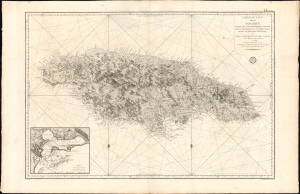
Carte de l'Ile de la Jamaique, extraite des Cartes topographiques Anglaises de T. Craskell... et de J. Simpson. Rédigée en 1786, corrigée et augmentée en 1799.
$1,500.00
Acquire
- Digital Map Information
- Suitable for large format printing
- Full resolution TIFF file
- ICC color profile embedded
- Delivered instantly via download link
This is a rare, large-format 1799 chart and map of Jamaica with an inset of Kingston Harbor. Issued in the wake of the Second Maroon War (1795), and overshadowed by the imminent French loss of Haiti to Toussaint Louverture, this map represents an effort by the French to absorb and utilize the best British information pertinent to Jamaica during a period in which both the British and the French were experiencing slave rebellion in the West Indies. Despite decades of war with each other, the Caribbean territories of these two slave-holding empires found common ground in the face of their respective revolts. British forces fought in Haiti in support of French planters until 1798; it may be that this work was produced in anticipation of returning the favor. (more details)