
de Winton, Sir Francis Walter
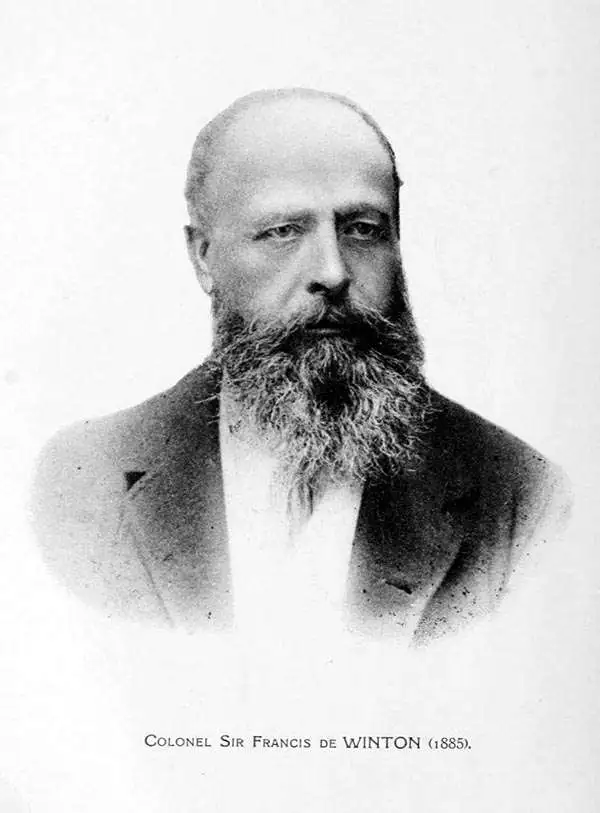
Sir Francis Walter de Winton (June 21, 1835 - December 16, 1901) was a British Victorian-era military officer, colonial administrator, and manager of royal houses. De Winton came from an established family; his father and grandfather had both been Members of Parliament while his uncles (Richard Collinson and Bernard Collinson) were important naval explorers of the early 19th century. De Winton attended the Royal Military Academy and was commissioned into the Royal Artillery, seeing action during the Siege of Sevastopol during the Crimean War. Afterwards, he served in various posts in North America and the Mediterranean, including as a military attaché to the Ottomans in Constantinople / Istanbul before becoming the private secretary of Marquess of Lorne, who was Governor General of Canada. In 1884, King Leopold II of Belgium appointed him as the Administrator-General of the International Association of the Congo (later the Congo Free State), succeeding Henry Morton Stanley. His tenure in the Congo was largely taken up by the demarcation of borders with colonial powers and African kingdoms. In 1887, he acted as Stanley's secretary on the Emin Pasha Relief Expedition before being assigned by the War Office to lead the Yoni Expedition in Sierra Leone at the end of that year. De Winton took on several other brief positions in Africa, including leading a diplomatic mission to the rulers of Swaziland and as governor of the Imperial British East Africa Company. In 1892, he returned to England to again undertake management of royal households, working as treasurer to the Duke of Clarence and then to King George V. Late in life, he was showered with accolades, including honorary degrees and the position of Honorary Secretary of the Royal Geographical Society in 1888-1889. In 1864, he married Evelyn Rawson (1846 - 1907), a daughter of Christopher Rawson, a leading minister in Canada, with whom he had two sons and two daughters.
African-American Creoles in Britain's Atlantic Empire.
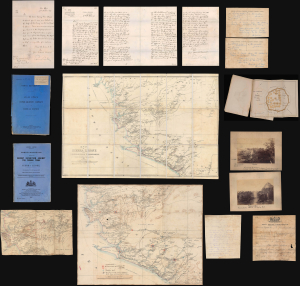
A remarkable find, this is an archive of maps, intelligence documents, and correspondence produced by the British War Office and Sir Francis de Winton relating to the 1887 Yoni Expedition in Sierra Leone, which de Winton led. This war had profound implications for the futures of freed African-American slaves settling in Freetown. The British launched this punitive military campaign against the Yoni to protect allied tribes in Sierra Leone's interior. Though a minor colonial conflict, the Yoni Expedition had wider significance as part of the 'Scramble for Africa'. Moreover, it included the British 1st West India Regiment, composed of descendants of enslaved people from Britain's North American colonies, including those who had joined the British during the American Revolution. (more details)