
1887 British War Office Yoni Expedition Archive, Sierra Leone

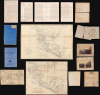
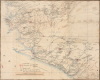
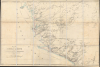
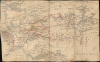
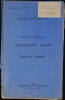
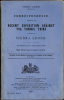
[Yoni Expedition Archive].
African-American Creoles in Britain's Atlantic Empire.
African-American Creoles in Britain's Atlantic Empire.
A remarkable find, this is an archive of maps, intelligence documents, and correspondence produced by the British War Office and Sir Francis de Winton relating to the 1887 Yoni Expedition in Sierra Leone, which de Winton led. This war had profound implications for the futures of freed African-American slaves settling in Freetown. The British launched this punitive military campaign against the Yoni to protect allied tribes in Sierra Leone's interior. Though a minor colonial conflict, the Yoni Expedition had wider significance as part of the 'Scramble for Africa'. Moreover, it included the British 1st West India Regiment, composed of descendants of enslaved people from Britain's North American colonies, including those who had joined the British during the American Revolution.A Closer Look
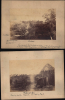
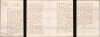
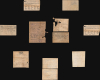
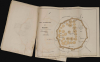
The archive includes three maps, the largest of which is a published 1886 War Office map of Sierra Leone, which has been dissected and laid on linen. One map (also laid on linen) appears to be an excerpt from the larger 1886 map with annotations added, marking frontier posts and whether they were under the command of an Inspector or Sub-Inspector. One such post was Robari, some 35 miles east of Freetown, which was the stronghold of the Yoni and the site of the decisive battle of the expedition. A third map also looks to be excerpted from the 1886 War Office map and traces in red what is likely the route of the expedition from Freetown to Robari and back. A map of Robari is also included as an appendix to the bound, confidential 'Staff Diary, Intelligence Report and Medical Report.' The archive also includes collected and printed correspondence relating to the expedition, issued by the War Office in 1888.Much of the archive consists of handwritten letters, telegraphs, and other correspondence. These include: a telegram from Garnet Wolseley, 1st Viscount Wolseley (1833 - 1913) initially soliciting de Winton's interest in leading the expedition; handwritten letters dated October 21, 1887 to Francis de Winton from the War Office in London, informing him of his appointment as leader of the planned expedition, its justifications, and its preparations; letters and photographs sent to the War Office by Francis de Winton from early December informing them of the progress of the expedition; and various other correspondence, including well-wishes from Princess Louise, Duchess of Argyll (1848 - 1939), the sixth child of Queen Victoria and Prince Albert, and her husband, John Campbell, Marquess of Lorne (1845 - 1914). (De Winton had previously worked as the private secretary of Campbell from 1878 to 1883 when the latter was Governor of Canada.) Taken together, these documents offer ground-level insight into the formation, progress, and conclusion of the expedition.
The Yoni Expedition
The Yoni Expedition of 1887 was a British military campaign launched against the Yoni chiefdom, a subgroup of the Temne people in the interior of Sierra Leone. The Yoni had been engaged in prolonged territorial conflicts and trade disputes with neighboring British-allied chiefdoms, such as the Kpaa-Mende and Bumpe. These clashes routinely disrupted the flow of commerce and resources to the coastal colony of Freetown. Initially, as had been the case previously, the British were reluctant to become too deeply involved in such power disputes in the interior, which they generally tried to mediate rather than decide with force. But in the context of the 'Scramble for Africa,' British officers were increasingly concerned about encroaching French colonial ambitions in West Africa, including the Rivières du Sud colony established in 1882 (today's Guinea). Indeed, Franco-British maneuvering in West Africa was a major impetus for the convening of the Berlin Conference of 1884 - 1885 (originally the 'Berlin West African Conference' though it eventually subsumed the entire continent), often seen as the key event in the 'Scramble for Africa.' Worries about French intentions and the drive to stake claims prompted the British administration in Sierra Leone to pivot from cautious diplomacy to direct military intervention.Led by Colonel Sir Francis de Winton, the expeditionary force assembled in November 1887 was a diverse coalition. It consisted of nearly 300 soldiers from the 1st West India Regiment, members of the Sierra Leone Police Corps, Royal Navy personnel, and hundreds of local allied irregulars and laborers who cut tracks through the dense terrain. Notably, this campaign marked one of the earliest combat deployments of the Maxim machine gun by British forces, which was utilized alongside rocket tubes and a 7-pounder field gun. Advancing inland from the Ribi River toward the Yoni stronghold of Robari, the heavily armed British column systematically dismantled local stockades, easily overpowering the Yoni defenders who relied primarily on obsolete muzzle-loaders. As a telegram included in the archive indicates, by December 21, de Winton was able to telegraph London: 'War finished. All well. Must wait orders before returning. Go see Wolseley.'
Known locally as the 'Whiteman's War,' the swift defeat of the Yoni chiefdom carried profound significance for the region. It signaled a definitive end to the era of loose commercial treaties between the British Crown and independent indigenous leaders in the Sierra Leone hinterland. By demonstrating overwhelming technological dominance (the British lost no troops and had only 20 wounded) and shattering local resistance, the Yoni Expedition established a precedent for aggressive territorial annexation, directly paving the way for the formal declaration of the Sierra Leone Protectorate in 1896.
Freetown, Sierra Leone, and the Legacy of Slavery
The context for the Yoni Expedition is notable for the close proximity of the fighting to Freetown, the development of that settlement, and the origins of some of the British units engaged. A pivotal group in the establishment of Freetown was the Black Loyalists - formerly enslaved African-Americans who secured their freedom by fleeing to British lines and fighting for the British Army during the American Revolutionary War (1775 - 1783). Promised land and liberty, many were initially evacuated to the harsh climate of Nova Scotia as the British withdrew from the former colonies. Dissatisfied with the broken promises of colonial authorities, a contingent of over 1,100 Black Loyalists sailed for West Africa in 1792. They cleared the land, laid out the streets, and officially named their new sanctuary 'Freetown,' embedding their military discipline and fierce desire for self-governance into the bedrock of the nascent colony.The cultural and political landscape of Freetown expanded dramatically in 1800 with the arrival of the Jamaican Maroons. These formidable fighters had engaged in fierce guerrilla warfare against British plantation owners in the Caribbean before also being exiled to Nova Scotia and subsequently relocated to Sierra Leone. Arriving just as the Nova Scotian settlers were staging a rebellion over taxes and land rights, the Maroons were used by the British to help quell the uprising (as they had been relied upon to suppress slave revolts in Jamaica and other West Indian colonies). Despite this initial friction, the Maroons, Nova Scotians, and an earlier group of London's 'Black Poor' gradually integrated. In subsequent years, Freetown was a staging ground for the Royal Navy's West Africa Squadron, which intercepted illegal slave ships following the abolition of the slave trade. Tens of thousands of rescued captives, known as Liberated Africans, were brought ashore and settled in Freetown. Through this profound melting pot of American, Caribbean, and diverse African traditions, the Krio (Creole) people emerged. This new elite pioneered Western-style education, commerce, and governance, transforming Freetown into an intellectual and cultural hub often referred to as the 'Athens of West Africa.'
It is also noteworthy that the core of the British force during the Yoni Expedition was the 1st West India Regiment, which had been formed just after the American Revolution and, like the settlers of Freetown, consisted of free people of color and enslaved men who (after 1807) were freed in exchange for their military service. During the Napoleonic Wars (1803 - 1815), volunteers for the West India Regiments were recruited from Sierra Leone and trained locally. Over the following decades, when suppressing or quelling unrest in Sierra Leone, the British generally sent West India Regiment troops garrisoned at Freetown, as during the Yoni Expedition. Often, upon the completion of their military service, soldiers from these regiments would stay in Sierra Leone and integrate into the local Creole community. The Sierra Leone Police Force was also drawn from the local Creole population in Freetown. Thus, the context of the Yoni Expedition was defined by successive waves of migration, beginning with the Middle Passage and continuing through the 'repatriation' of African-Americans from the West Indies and North American colonies.
Publication History and Census
This archive consists of maps, telegraphs, letters, and other information relating to the 1887 expedition produced primarily by the War Office or by de Winton himself. While some of the materials were published, such as the War Office 'Map of Sierra Leone and Neighbouring Territories' and the printed 'Correspondence respecting the recent expedition against the Yonnie tribe adjacent to Sierra Leone,' most of these documents are entirely unique, as is the archive as a whole.Cartographers
Sir Francis Walter de Winton (June 21, 1835 - December 16, 1901) was a British Victorian-era military officer, colonial administrator, and manager of royal houses. De Winton came from an established family; his father and grandfather had both been Members of Parliament while his uncles (Richard Collinson and Bernard Collinson) were important naval explorers of the early 19th century. De Winton attended the Royal Military Academy and was commissioned into the Royal Artillery, seeing action during the Siege of Sevastopol during the Crimean War. Afterwards, he served in various posts in North America and the Mediterranean, including as a military attaché to the Ottomans in Constantinople / Istanbul before becoming the private secretary of Marquess of Lorne, who was Governor General of Canada. In 1884, King Leopold II of Belgium appointed him as the Administrator-General of the International Association of the Congo (later the Congo Free State), succeeding Henry Morton Stanley. His tenure in the Congo was largely taken up by the demarcation of borders with colonial powers and African kingdoms. In 1887, he acted as Stanley's secretary on the Emin Pasha Relief Expedition before being assigned by the War Office to lead the Yoni Expedition in Sierra Leone at the end of that year. De Winton took on several other brief positions in Africa, including leading a diplomatic mission to the rulers of Swaziland and as governor of the Imperial British East Africa Company. In 1892, he returned to England to again undertake management of royal households, working as treasurer to the Duke of Clarence and then to King George V. Late in life, he was showered with accolades, including honorary degrees and the position of Honorary Secretary of the Royal Geographical Society in 1888-1889. In 1864, he married Evelyn Rawson (1846 - 1907), a daughter of Christopher Rawson, a leading minister in Canada, with whom he had two sons and two daughters. Further Details...
The British War Office (1857 - 1964) was a department of the British Government responsible for the administration of the Royal Army until 1964, when its functions were transferred to the Ministry of Defense. The War Office was to the Royal Army what the Admiralty was to the Royal Navy, and later, the Air Ministry. Within the War Office, the General Staff Topographical Section was responsible for thousands of maps issued for British intelligence and military use. The Topographical Section was renamed Geographical Section in April 1907. Many, once their military use passed, were offered through licensed agents to the general public. The sole London agent for War Office material was Edward Stanford. Further Details...
Condition
Very good overall. Some telegrams have areas of loss. Some soiling to 'Staff Diary, Intelligence Report, and Medical Report' which is also missing the back cover.
References
Ijagbemi, E., 'The Yoni Expedition of 1887: A Study of British Imperial Expansion in Sierra Leone,' Journal of the Historical Society of Nigeria June 1974, Vol. 7, No. 2, pp. 241-254.