
Ōtsuki Bankei (大槻盤渓)
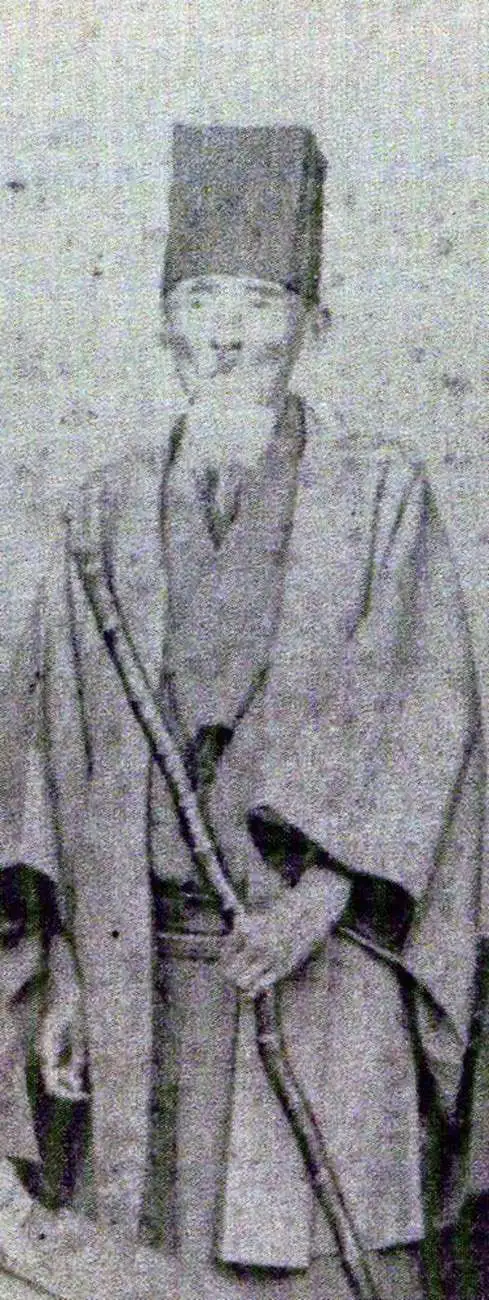
Ōtsuki Bankei (大槻盤渓; June 25, 1801 - June 13, 1878) was a draughtsman, painter, political figure, and leading Japanese Sinologist and expert on Confucianism in the late Tokugawa and early Meiji eras. His father was Ōtsuki Gentaku (大槻玄沢, 1757 - 1827), a feudal lord in Sendai Domain and a prominent Rangaku scholar. Legend holds that Ōtsuki Gentaku steered his son towards Sinology so that the works he had translated from Dutch into Japanese could then be translated into Classical Chinese, a form revered by Tokugawa Japan's intelligentsia, and thereby gain greater influence. Through his father's connections, at the age of 16, Ōtsuki Bankei began to study the Chinese Classics with Hayashi Jussai (1768 - 1841) and Matsuzaki Kōdō (1771 - 1844). He would continue his studies in the following years, both attending and teaching at the Sendai domain school of Yōkendō (養賢堂, which he would later head), a major center of Sinology and Confucian studies. When he was 27 years old, Ōtsuki undertook a long journey throughout Japan, eventually ending in Nagasaki to study Rangaku; he encountered many leading scholars along the way and wrote an account of his trip titled 'Journey to the West' (西遊紀程), a play on the name of the classical Chinese epic story. However, soon afterwards his father became ill and died, forcing Ōtsuki Bankei to return to Sendai, ending his flirtation with Rangaku. He then settled in Edo and focused on Sinology. However, during his brief stay in Nagasaki, he had encountered Takashima Shūhan (1798 - 1866), an early Japanese expert on modern Western artillery, and like Takashima became determined to domesticate this technology. By 1851, Ōtsuki was appointed Sendai's expert on Western artillery and shortly thereafter instructed to begin constructing his own canons. From 1849, Ōtsuki openly advocated opening the country, a still fairly scandalous position, and believed that Japan could use Russian influence to ward off American and British commercial dominance to avoid a fate similar to Qing China in the First Opium War (1839 - 1842). On both appearances of Perry's 'Black Ships' off Japan's shores, Ōtsuki advised that the Americans should be received peacefully and he penned a poem that impressed Luo Sen (1821 - 1899), Perry's Chinese interpreter. He also consulted with Yoshida Shōin (1830 - 1859) before the latter's failed attempt to stowaway aboard one of Perry's ships; Yoshida was said to be carrying a copy of an 1844 world map (新製輿地全圖) which Ōtsuki helped prepare when he was captured. Ōtsuki retuned to Sendai to serve as head of Yōkendō, but then became embroiled in the Boshin War between the 'restorationists' supporting the Meiji Emperor and those loyal to the Tokugawa. With the Tokugawa loyalists on the losing side of the conflict, Ōtsuki was imprisoned and many of his associates and students were executed. He himself was intended to be beheaded but was shown leniency given his scholarly status and advanced age. He was released from prison in 1870 and after a period of house arrest moved to Edo (now Tokyo) in 1871. He passed a quiet retirement in Tokyo, watching the monumental changes underway in Japan with keen interest, feeling vindicated in his earlier belief that the country needed to open to the West.
AKA: 大槻盤渓
One of the Most Influential Japanese Maps of the 19th Century. / Japanese recognition of the Sea of Korea.
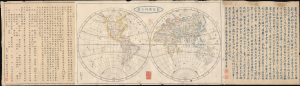
新製輿地全圖 / [Newly-Made Complete Map of the World].
$2,500.00
Acquire
- Digital Map Information
- Suitable for large format printing
- File Size: 30.62 MB
- File Type: ZIP / TIFF
- ICC color profile embedded
- Delivered instantly via download link
This is a fascinating 1844 Mitsukuri Shōgo double-hemisphere world map with descriptive text. Based on a somewhat earlier French map, it is important in the migration of Western geographic knowledge to Japan, even in the years before Japan was 'forced open' by American warships, hastening the end of its period of isolation. It is also unusual as one of the very few Japanese maps to recognize the 'Sea of Korea' toponym. (more details)