
Viollet-le-Duc, Eugène Emmanuel
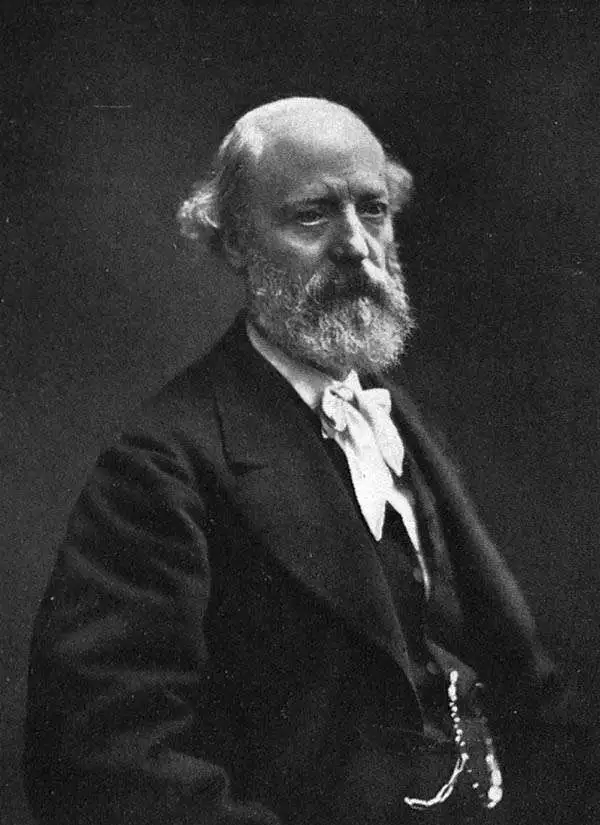
Eugène Emmanuel Viollet-le-Duc (January 27, 1814 - September 17, 1879) was a French architect, restorer of historical sites, and amateur geologist and geographer of Mont Blanc in the Alps. Viollet-le-Duc grew up in a well-connected and intellectually vibrant Parisian household; his father was governor of royal residences under the July Monarchy. A talented artist from a young age, Viollet-le-Duc was interested in historical buildings and their structure, but insisted on learning architecture through self-directed study and extensive travel rather than attending the rigid but well-regarded École des Beaux-Arts. His artistic skill was such that at age 20, he was made an associate professor at the Royal School of Decorative Arts. He traveled widely, producing paintings and drawings, many of which appeared in Voyages pittoresques et romantiques dans l'ancienne France. Viollet-le-Duc also gained practical experience in architecture while working under Achille Leclère, who arranged for him to work on projects for government buildings. In 1840, he was tasked with restoring the Vézelay Abbey, damaged in the Wars of Religion and the French Revolution, a daunting task as there was no plans to work with and very little published information on Medieval architecture at the time. Although he had to modify some elements of the Abbey to ensure stability, Viollet-le-Duc managed to rescue the structure, which likely would have collapsed within a few decades otherwise. His success led to his being brought in to consult on other historical restoration projects, including Sainte-Chapelle in Paris. In 1844, he and Jean-Baptiste Lassus were tasked with restoring Notre-Dame Cathedral, which had also been badly damaged during religious and political strife. Over the following decades, Viollet-le-Duc became the most prominent restorer of Medieval sites in France, working on churches, cathedrals, and castles, along the way becoming a professor at the École des Beaux-Arts. He generally oversaw multiple restoration projects at once as the work took years to complete and his expertise was in high demand, leading to his traveling almost constantly. Always controversial and shunned by most formally trained architects, he championed a bold and controversial restoration philosophy aimed at re-establishing historical buildings into a state of complete structural idealization that may never have actually existed. His influential theoretical writings argued that a building's form must follow its materials and function, a concept of 'structural rationalism' that deeply inspired later masters of modern architecture, including Antoni Gaudí, Louis Sullivan, and Frank Lloyd Wright. In his later years, Viollet-le-Duc harmonized his architectural theories with the natural world, dedicating eight summers between 1868 and 1876 to an obsessive cartographic and geological study of the Mont Blanc massif. Viewing mountains as nature's grandest architecture, he rejected contemporary military maps as inaccurate and painstakingly produced his own highly detailed 1:40,000 scale topographical map using sophisticated shading to render three-dimensional alpine terrain. His resulting 1876 book, Le Massif du Mont Blanc, advanced a unique theory that the mountain was originally formed as a perfectly regulated rhombohedral crystalline system that was being slowly 'ruined' by glacial erosion. By mapping the massif, Viollet-le-Duc sought to mentally 'restore' the mountain to its primordial blueprint, applying the same logic to nature that defined his architectural work. In his later years, Viollet-le-Duc contributed to the design of the Statue of Liberty, the Paris Universal Exposition of 1878, and National Museum of French Monuments. In 1834, he married Elisabeth Tempier, with whom he had two children, but the couple separated after a few years due to Viollet-le-Duc's continuous travels to various restoration sites around France.
Greatest Map of Mont Blanc Ever Made.
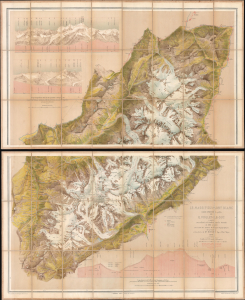
Le Massif du Mont Blanc.
$5,500.00
Acquire
- Digital Map Information
- Suitable for large format printing
- Full resolution TIFF file
- ICC color profile embedded
- Delivered instantly via download link
This is Eugène Emmanuel Viollet-le-Duc's stunning chromolithographic 1876 map of Mont Blanc, produced after years of studying the massif's geography and geology. It is considered the greatest map of Mont Blanc ever produced, reflecting Viollet-le-Duc's artistic skills and unique experience as France's premier restorationist of historic sites. The map's production also coincided with territorial disputes between France and Italy (still unresolved) following the 'return' of Mont Blanc to France in 1860. (more details)