
White, Roberto J.

Roberto J. White (fl. c. 1918 - 1928) was a civil engineer (Ingeniero Intendencial) in the department (then intendencia) of Chocó in Colombia best known for planning a never-completed 'interoceanic' road between Quibdó and Negría, and producing a related 1924 map. He was part of the prominent Blake White - Uribe family of Colombia, descended from three British brothers from the Isle of Wight who settled in Colombia and worked as mining engineers in the 1860s. One of the brothers, Robert (or Roberto, 1840 - 1907), married María del Rosario Prudencia Uribe (his younger brother, John Henry White Blake, 1846 - 1925, married María Rita Eugenia Gregoria Uribe, presumably a relative of María del Rosario Prudencia Uribe). Roberto J. White Uribe was one of the children of Robert White Blake and María del Rosario Prudencia Uribe. Several members of his extended family (particularly his cousins - the sons of John Henry) also became prominent in mining and related fields in the late 19th - early 20th century. Aside from his unrealized Quibdó-Negría road, White was involved in early surveys and planning for roads designed to connect Chocó's isolated interior with neighboring departments, including early route options for the Quibdó - Medellín route, a decades-long project through treacherous mountainous terrain.
A Planned Interoceanic Route in Colombia's Remote Northwest.
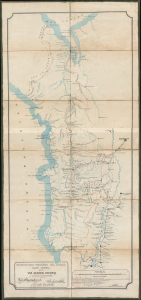
Intendencia Nacional del Choco. Plano general de la via Quibdo Negria y de algunas de sus conexiones.
$950.00
Acquire
- Digital Map Information
- Suitable for large format printing
- Full resolution TIFF file
- ICC color profile embedded
- Delivered instantly via download link
This is a c. 1924 map of the Chocó intendencia (now a departamento) in northwest Colombia, prepared by the territory's Anglo-Colombian engineer, Roberto J. White. The map presents an ambitious scheme White laid out to connect north- and south-running rivers in Chocó that empty into the Atlantic and Pacific Oceans, respectively, creating an interoceanic route capable of handling heavy cargo. This was a particularly important goal at the time as Chocó became one of the main international sources of platinum in the early 20th century and experienced a mining boom. (more details)