
Meurs, Jacob van

Jacob van Meurs (c. 1620 - 1680) was a Dutch engraver active in Amsterdam during the second half of the 17th century. Van Meurs is best known for his collaboration with Arnoldus Montanus in the publication of numerous engraved maps and views for Montanus' various influential histories and travel narratives. Some of his most important works include a few of the earliest known views of the Americas (including New York City), Japan, and China.
Elegantly Composed Double Hemisphere World Map.
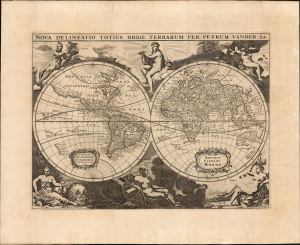
Nova Delineatio Totius Orbis Terrarum Per Petrum Vander Aa.
$1,750.00
Acquire
- Digital Map Information
- Suitable for large format printing
- File Size: 15.01 MB
- File Type: ZIP / TIFF
- ICC color profile embedded
- Delivered instantly via download link
This elegant double-hemisphere map of the world, engraved in 1660 by Jacob van Meurs, encapsulates the European understanding of the world during the second part of the 17th century. It is notable as well for its stately decorative imagery. (more details)
Early French Settlement in Florida.
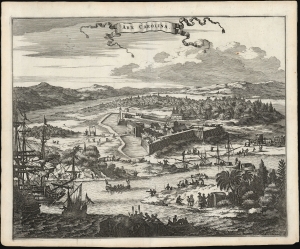
Arx Carolina.
$750.00
Acquire
- Digital Map Information
- Suitable for large format printing
- File Size: 13.88 MB
- File Type: ZIP / TIFF
- ICC color profile embedded
- Delivered instantly via download link
This is a beautifully realized 1671 Arnoldus Montanus view of Arx Carolina, or Fort Caroline, situated on the present-day St. John's River, in the vicinity of Jacksonville, Florida. It portrays the French Huguenot fort, imagined as it was before its 1565 destruction by the Spanish. (more details)
Oldest European City in the United States.
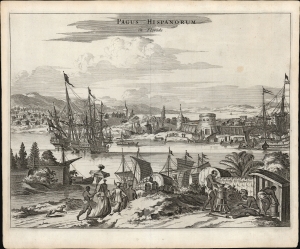
Pagus Hispanorum in Florida.
$850.00
Acquire
- Digital Map Information
- Suitable for large format printing
- File Size: 11.4 MB
- File Type: ZIP / TIFF
- ICC color profile embedded
- Delivered instantly via download link
This is a beautifully realized Arnoldus Montanus/John Ogilby view of the Spanish settlement of St. Augustine, Florida, the oldest European city within the bounds of what would be the United States. St. Augustine was founded by Pedro Menendez in 1565 to protect the northernmost frontier of the Spanish Empire on America's east coast and to project Spanish power over the trade route passing from the Gulf of Mexico through the passage between Florida and the Bahamas. (more details)
Among the First Views of Colonial Mexico City.
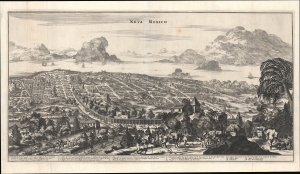
Nova Mexico.
$600.00
Acquire
- Digital Map Information
- Suitable for large format printing
- File Size: 22.63 MB
- File Type: ZIP / TIFF
- ICC color profile embedded
- Delivered instantly via download link
A rare and impressive view of Mexico City from John Ogilby's 1671 America. This is one of the first representations of Mexico City as a Spanish colonial center. (more details)
Beautifully Engraved 17th Century View of Damascus.
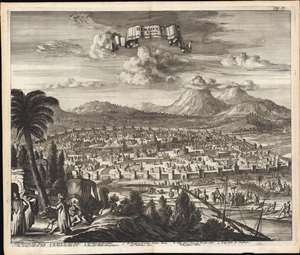
Damascus in Syrien Volgens des Afteeckening gedaen in 't Iaer 1668.
$750.00
Acquire
- Digital Map Information
- Suitable for large format printing
- Full resolution TIFF file
- ICC color profile embedded
- Delivered instantly via download link
This is a beautiful example of Jacob Meurs' engraved view of the Syrian city of Damascus, printed in 1681 as part of Olfert Dapper's history of Asia Minor and the Holy Land. The view is intended to portray the contemporaneous Muslim walled city; its mosques prominent. Some churches illustrated as well, though one of these, the Church of Saint Paul, is in ruins. In the foreground, noblemen in Ottoman styles converse as footmen lead their camels, replete with a covered chaise, towards the city. Before the walls of the city, the view presents a bustling scene of nobles, fishermen, cattle herders and soldiers. (more details)