
Servetus, Michael
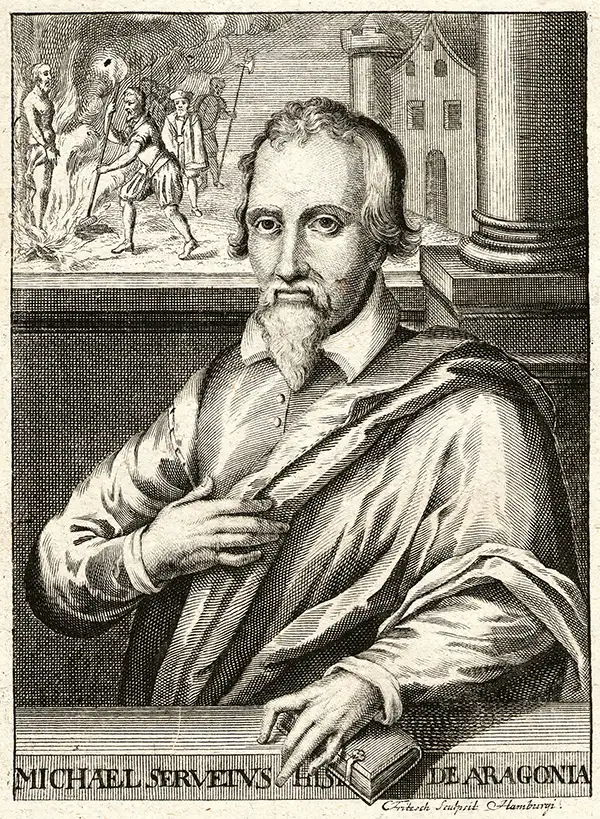
Fritzsch, Christian (Herzog August Bibliothek Wolfenbüttel; Bilddatei: haba-20231)
Michael Servetus (1509/11 - October 27, 1553), also known as Miguel Servet, Michel de Villeneuve, and Michael Villanovanus or Villanovus, was a Spanish physician, theologian, humanist, and geographical editor whose career united Renaissance scholarship with the religious controversies of the Reformation. He studied law at Toulouse before pursuing theological questions that brought him into conflict with both Catholic and Protestant authorities; his De Trinitatis Erroribus (1531) and Dialogorum de Trinitate (1532) challenged orthodox Trinitarian doctrine, prompting him to adopt the name Michel de Villeneuve and establish himself in France. Working with the Trechsel printing firm in Lyon, he edited the 1535 and 1541 editions of Ptolemy’s Geographia, the works through which his name is most familiar to map collectors. His geographical contribution was principally editorial: he revised the Latin text, supplied explanatory material, and compiled descriptions of countries and their inhabitants, drawing extensively on earlier authorities. These editions place him within the Renaissance effort to reconcile classical geographical learning with contemporary knowledge, although modern scholarship cautions against treating all his descriptive material as original. Peter Hughes, Michael Servetus's Britain. Servetus subsequently studied medicine in Paris, assisting the anatomist Johann Günther von Andernach, and eventually settled in Vienne as physician to Archbishop Pierre Palmier. His theological interests continued alongside his medical practice, culminating in Christianismi Restitutio (1553), which contained the first published European description of pulmonary circulation—the passage of blood from the right side of the heart through the lungs to the left. Publication exposed his concealed identity and led to his arrest by Catholic authorities in Vienne; after escaping imprisonment, he traveled to Geneva, where he was arrested again and prosecuted for heresy, with John Calvin playing a leading role in the proceedings. Condemned by Geneva’s council for his religious teachings, including his rejection of orthodox Trinitarian doctrine and infant baptism, Servetus was burned at the stake on October 27, 1553. His execution provoked an enduring controversy over religious persecution and helped make him a central figure in the history of freedom of conscience.
One of the Earliest maps to name America.
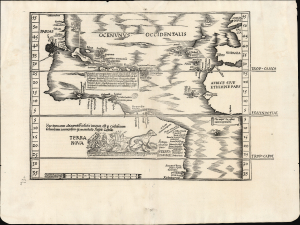
[Tabula terrae novae]
$13,500.00
Acquire
- Digital Map Information
- Suitable for large format printing
- Full resolution TIFF file
- ICC color profile embedded
- Delivered instantly via download link
A cartographic landmark, this is Lorenz Fries' edition of the first separate, printed map of America. First printed in 1522, it succeeds and synthesizes Martin Waldseemüller's 1513 Tabula Terre Nove and his 1516 Carta Marina. No improved, acquirable map of this part of the world appeared until Münster's 1540 map of the Americas. (more details)
Spreading the Age of Discovery.
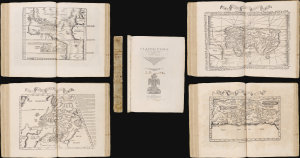
Claudii Ptrolemaei Alexandrini Geographicae Enarrationis Libri Octo Ex Bilibaldi Pirckeymheri tralatione...
$55,000.00
Acquire
This is Lorenz Fries' expanded version of Ptolemy's Geography: an attractive, complete example of the 1535 issue edited by Michael Villanovus (Servetus). It is a key document of the Discovery Era, containing an array of the earliest disseminated maps of Africa, the Indies and the New World; one of its trio of world maps is the earliest acquirable map to name 'America.' This 1535 Servetus edition is scarce. Many were burned when the editor was condemned for heresy in 1553: only one example of this edition is listed in an institutional collection. (more details)