
1944 American Battle Monuments Commission History of the 92nd Division in World War I

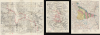
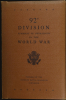
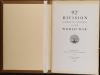
92d Division Summary of Operations in the World War.
Buffalo Soldiers in World War I.
$750.00
Choose a Collection:
- Digital Map Information
- Suitable for large format printing
- Full resolution TIFF file
- ICC color profile embedded
- Delivered instantly via download link
This Item
Enquire
Buffalo Soldiers in World War I.
This is a 1944 American Battle Monuments Commission unit history of the 92nd Infantry ‘Buffalo Soldiers’ Division in World War I (1914 - 1918). The all-African American division included the celebrated Harlem Hellfighters. This history, and the over 20 others in this series, are the only official U.S. government unit histories published concerning the combat history of the WWI American Expeditionary Force.A Closer Look
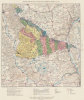
The text is 45 pages long and includes a 30-page narrative along with a map of Western Europe, an appendix, and an index. Three large folding maps are stored in a sleeve inside the front cover. These are as follows:- American Operations in the St. Mihiel Region, September 12-November 11, 1918. Published in 1937, this map illustrates the entire St. Mihiel region, from Verdun to Metz and from Étain to Toul and Nancy. Towns and villages are labeled throughout, along with forests, woods, and other important landmarks. The colored areas indicate territory gained by American divisions during the St. Mihiel Offensive, and blue lines trace the advancing front line. The circled numbers refer to specific American divisions, with the 92nd occupying the sector farthest on the right. This map measures 28.5x24 inches.
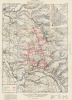
- 92d Division Meuse-Argonne Offensive September 26-October 5, 1918. This map depicts the region occupied by the 92nd Division and the advance of the Division's front line between September 26 and October 5, 1918. Specific regiments are identified as holding specific parts of the line. This map measures 26.75x19 inches
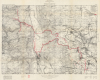
- 92d Division Marbache Sector and Woëvre Plain Operation October 8-November 11, 1918. This map illustrates the advance of the 92nd's front line from October 8 until the end of World War I. Bold red lines trace the division's progress and provide a geographic visual summary. This map measures 29.75x36.75 inches.
Buffalo Soldiers - Fighting for America
The 92nd Infantry Division was an African American U.S. Army division that served during both World War I and World War II. They were known as Buffalo Soldiers after the black-and-red emblem of the Division. The U.S. Army, like the United States as a whole, was racially segregated during both World Wars. The 92nd was organized in October 1917 from Selective Service draftees from across the United States and trained in camps from Kansas to New York. It was sent overseas on July 18, 1918, and 'loaned' to the French Army, where they would wear American uniforms but use French equipment. Most of the division moved toward the front line on September 24 in the Argonne Forest and took part in the Meuse-Argonne Offensive (September 26-October 5). After the Meuse-Argonne, the 92nd saw action in the Marbache Sector and the Woevre Plain Operation until the end of the war on November 11.The American Battle Monuments Commission
The American Battle Monuments Commission (ABMC) was established by the U.S. Congress in 1923 to commemorate the service and sacrifice of members of the armed forces who died overseas, particularly during World War I. Before its creation, the graves of American soldiers in Europe were managed temporarily by the U.S. Army's Graves Registration Service, but in the aftermath of the war, with its tremendous casualties, it became clear that a permanent organization was needed to design, build, and maintain fitting memorials. Under the leadership of its first chairman, General John J. Pershing (former commander of the AEF), the ABMC undertook the monumental task of organizing and overseeing the construction of cemeteries across Europe. The Commission worked closely with leading American architects and sculptors, emphasizing dignity, permanence, and uniformity in its designs to reflect the unity and sacrifice of the fallen.During its early years, the ABMC established eight permanent World War I cemeteries in France, Belgium, and England, including the Meuse-Argonne (Romagne Montfaucon here) and Suresnes American Cemeteries, and erected numerous memorials and monuments at key battle sites. By the late 1930s, the Commission had become internationally recognized for its artistry, efficiency, and respect for the dead, setting enduring standards for war memorial design. In subsequent decades, the ABMC took on management of cemeteries for American dead from the Philippine-American War, World War II, the Korean War, the Vietnam War, and, much after the fact, a cemetery of American dead from the Mexican-American War in Mexico City.
Publication History and Census
This book was prepared by the American Battle Monuments Commission and published by the United States Government Printing Office in 1944. It is well represented in institutional collections but scarce on the private market.Condition
Very good. Octavo. 45pp. Shelf wear to cover. Accompanied by 3 maps stored folded inside front cover. Maps vary in size. All maps in very good condition with wear along original fold lines and verso repairs to fold separations and/or fold intersections and light wear along original fold lines.
References
OCLC 1024752.