
1954 Luciolli Persuasive Poster, Sino-Soviet Alliance, Cold War

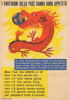
I partigiani della pace hanno buon appetito.
Italian Catholics' Information War against Mao Zedong.
$1,200.00
Choose a Collection:
This Item
Enquire
Italian Catholics' Information War against Mao Zedong.
This is a very scarce 1954 Italian persuasive poster prepared by Giovanni Luciolli denouncing the Chinese Communist Party and 'Bolshevism' more broadly. It reflects the evolving politics and internationalization of the Cold War; by this time, Italy was safely within the Western camp, but fears of global Communist conspiracies were widespread, particularly on the right-wing, in Western democracies.A Closer Look
The poster depicts a Chinese dragon emblazoned with a hammer and sickle attempting to swallow the entire globe. The title refers to skepticism about China's promotion of peace during and after the Korean War, which had only recently been paused by an Armistice in July 1953. Chinese Communist and Soviet propaganda of the era often depicted the U.S. and its allies as impediments to world peace, which was wholeheartedly desired given the horrific destruction of the recent world war. However, as the makers of this poster (correctly) inferred, the promotion of 'world peace' was essentially a cover for opposition to any form of anti-Communist military alliance (i.e. NATO) or other coordinated multinational anti-Communist effort. Below the illustration, a textbox refers to a document in which Chinese Communist leader Mao Zedong discusses plans to 'Bolshevize the entire world in about ten years.' This is followed at bottom by a poem warning Mao that such a scheme will provoke a furious reaction.It is unclear what document the poster refers to, though Mao was prone to making provocative and even shocking offhanded comments about global war and revolution. It was a common belief in the West, and especially on the political right, that Communist movements the world over were acting in concert as part of a master plan; a not-wholly-inaccurate interpretation, at least while Stalin was alive, though one which tended to underestimate internal dissension and competing national interests among Communists. Indeed, at this moment, the Communist camp was in the early phase of a recalibration following the death of Stalin, a process that would result in Khruschev's stunning 'secret speech' two years later, the Hungarian Revolution, and the Sino-Soviet Split.
Comitati Civici
This poster appeared as a supplement to the Il Corriere del Cittadino, a illustrated publication aligned with the Comitati Civici (Civic Committees). These Comitati emerged in Italy in 1947-1948 as a mass political mobilization movement closely tied to the Christian Democracy (Democrazia Cristiana, DC) Party and strongly backed by the Catholic Church. Created under the leadership of Luigi Gedda (then Vice-President and later President of the lay organization Azione Cattolica), they were designed to counter the growing strength of the Italian Communist Party (PCI) and the left-wing Popular Democratic Front. Operating through parish networks, Catholic associations, and grassroots volunteer cells, the Comitati Civici organized door-to-door canvassing, distributed millions of leaflets, staged rallies, and coordinated voter registration drives. They played a decisive role in the 1948 general election, helping the DC secure a sweeping victory that kept Italy firmly anchored in the Western camp.In the broader Cold War propaganda struggle, the Comitati Civici functioned as a domestic front line of psychological and cultural warfare. Their messaging closely echoed and amplified U.S.-supported information campaigns, including material indirectly provided by the Central Intelligence Agency and U.S. Embassy. By blending religious authority, emotional appeals, and modern mass-communication techniques, the Comitati Civici became one of the most effective examples of anti-Communist mobilization in Postwar Europe.
Though their membership waned after the critical 1948 election, the Comitati continued to produce persuasive works such as the present poster for several years afterwards. Eventually, the Gedda-aligned Comitati Civici were sidelined as the DC developed its own internal bodies for information distribution and mobilization, and ideological differences (namely, Gedda's willingness to work with neo-fascists) drove the two camps apart.
Publication History and Census
This poster was produced as a supplement to the Comitati Civici-aligned publication Il Corriere del Cittadino, directed by Giovanni Luciolli, in July 1954. Based on the information in the annual reference work Annuario della stampa italiana, Il Corriere del Cittadino ceased operation around 1960 (it should not be confused with a later, still-extant publication by the same name that began in the 1980s), and we have been unable to locate any information about Luciolli. This poster was printed by the firm Artec-Sagra. The poster is very scarce; there are no other examples in institutional collections or on the market.Condition
Good. Some edge repairs. Wear on old fold lines. Some old tape on verso.