
1960 Commissariat Generale du Tourisme Map of Corsica, France

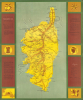
The Fifteen Marvels of Corsica / Corse France.
The Isle of Beauty.
The Isle of Beauty.
This is a colorful c. 1960 tourist map of Corsica, produced by France's Commissariat générale du tourisme. It provides a broad overview of the island's rich culture, history, and products.A Closer Look
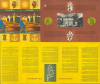
The map displays the island of Corsica, emphasizing the mountains running down the center of the island, which constitute most of its land area, with peaks labeled and elevations given. Cities are labeled throughout, including Ajaccio, the island's capital and largest city, towards the bottom-left. Maritime routes from Ajaccio and other ports are traced, with the distance to major ports in France, Italy, and North Africa recorded. Roads are traced, while small illustrations indicate the locations of churches, airfields, historical ruins, resorts, vineyards, lighthouses, and more.Side panels list the 'fifteen marvels of Corsica,' including the birthplace of Napoleon, and include illustrations relevant to the island, such as its distinctive coat of arms, based on the symbol of the short-lived Corsican Republic in the mid-18th century. The verso contains a vignette illustration of the house in Ajaccio where Napoleon was born, along with a translated paean to Corsica by Alphonse Daudet. On the opposite side are textual descriptions and a small map of several suggested excursions. The art on the title panel was drawn by Éric Lancaster (1911 - ?), known for his mid-twentieth-century tourist posters.
Historical Context
Although issued by a French government agency, this map emphasizes Corsica's distinct identity and history. During World War II (still a recent memory when this map was published), the island was initially under the control of Vichy France, but after the Allied landings in North Africa in November 1942, Axis forces occupied the island; Italian troops took control of most of Corsica, while German forces established a presence in the north. The Italian occupation was relatively lenient compared to German rule elsewhere, and many Corsicans joined the Resistance. After Italy's armistice with the Allies in September 1943, Italian troops largely switched sides, helping Corsican partisans and Free French forces expel the Germans. By early October 1943, Corsica became the first part of metropolitan France to be fully liberated, serving briefly as a strategic base for Allied operations in the Mediterranean.In the postwar period, Corsica remained politically tied to France but continued to feel economically marginalized and culturally distinct. The island was swept up in the tensions of the May 1958 Crisis, when political instability in Paris over the Algerian War (1954 - 1962) led to fears of civil war and the eventual fall of the Fourth Republic. On Corsica, pro-Gaullist officers and settlers sympathetic to French Algeria staged a local coup in Ajaccio on May 24, 1958, in support of Charles de Gaulle's return to power. Though bloodless, the 'Operation Corse' demonstration played an important symbolic role in the broader chain of events that brought de Gaulle to the premiership and inaugurated the Fifth Republic. The episode also reflected Corsica's complex political identity - loyal to France yet marked by localism and its own brand of nationalism that would reemerge more forcefully later in the century.
Publication History and Census
This map was issued by the Commissariat Générale du Tourisme. It is undated, but the name of the office (as opposed to the earlier Direction générale du tourisme) suggests a date of 1959 or later. The present map is cataloged among the holdings of the Bibliotheek Universiteit van Amsterdam and the Bibliothèque nationale de France, while a potential earlier edition (issued by the Direction générale du tourisme) is held by the University of Arizona, Université Laval, and the National Library of Scotland.Cartographer
Direction générale du tourisme (1927 - 1965) was an office within the Ministère des travaux publics, des transports et du tourisme tasked with promoting France to potential foreign tourists, an important part of France's postwar economic recovery. Originally named the Commissariat général au tourisme, its name was changed to the Direction générale in 1948 before changing back to its original name in 1959. France's tourist promotion bureaucracy has undergone several reorganizations, eventually falling under the Ministère du Commerce, de l'Artisanat et du Tourisme, now simply named the Ministère du Commerce. Further Details...
Condition
Very good. Light wear along original fold lines. Text and illustrations on verso.
References
OCLC 1454845904, 1131482642 (earlier edition?).