
1915 Poole Brothers Map of Florida Railways, Louisville and Nashville Network

This item has been sold.
Florida America's Famous Winter Resort State... / Florida Cuba Louisville and Nashville R.R.
Linking the Sunshine State.
- Digital Map Information
- Suitable for large format printing
- Full resolution TIFF file
- ICC color profile embedded
- Delivered instantly via download link
Linking the Sunshine State.
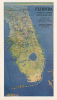
This is a rare 1915 Poole Brothers pictorial railway map of Florida, appearing in a promotional booklet for the Louisville and Nashville Railroad. It was published at a time when Florida had become well-established as a resort destination for Northerners, aided by the expansion of rail networks to the state's furthest reaches.A Closer Look
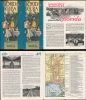
Issued at a defining moment in Florida's emergence as a tourist mecca, the map captures the state on the cusp of the great land boom of the 1920s, driven by breakneck expansion of rail and steamer services. Coverage spans the full length of Florida, from Jacksonville and Fernandina in the north to Key West and Cuba, with the railroad network of the Louisville and Nashville, and its connections, overlaid prominently in bold lines. Cities, towns, lakes, and rivers are densely noted throughout, with the state's distinctive lake-studded interior rendered in appealing color. The folding brochure includes evocative cover art depicting fashionable tourists at leisure, interior text promoting the L. and N.'s trains and services, and promotional text for Florida.Historical Context
By 1915, Florida had become the preferred winter destination of America's prosperous classes, and the railroads were its gatekeepers. The Louisville and Nashville, operating from the Midwest and Upper South through to Jacksonville and beyond, competed fiercely for this lucrative winter traffic. From 1908, the L and N worked in conjunction with Henry Flagler's Florida East Coast Railway to run a portion of the famous Dixie Flyer service from Chicago to Miami. From 1912, with the completion of Flagler's Overseas Railway to Key West, Cuba felt like a natural extension of Florida, a connection that the 1935 Labor Day hurricane severed.Florida Land Boom(s)
In the second half of the 19th and throughout the early 20th century, Florida experienced a series of land booms and crashes. The initial land boom established Florida as a center for the citrus industry in the 1880s - 1890s, and its collapse allowed for the easy acquisition of large tracts of land at cut-rate prices. Industrialist and founder of Standard Oil, Henry Flagler (1830 - 1913) seized the opportunity to build his Florida East Coast Railway and extend it to the region that would develop into Miami and other communities on the state's southeastern coast. Henry B. Plant's eponymous system of railroads and steamships accomplished similar results in the Tampa Bay region.Flagler, Plant, and other Florida boosters successfully promoted the state as a paradisical escape from the grimy cities and cold weather of lands further north. Land prices shot up at an astronomical rate, and developers carved entirely new cities out of wetlands in mere months. In addition to Flagler's railway, the arrival of the highway system in the 1920s made the region more easily accessible. But speculation in land prices in Florida had reached irrational heights, and the damage from two hurricanes, followed by the financial crash of 1929, led to a collapse in the real estate market, ruining many investors in the process.
Publication History and Census
This map was printed by Poole Brothers in 1915 for the Louisville and Nashville Railroad. Railroad promotional booklets and maps of this type are inherently ephemeral, produced in large quantities for distribution to travelers but rarely preserved, making surviving examples in good condition scarce. Significantly later editions of a booklet with the same title but notably differing content are held by Florida International University (OCLC 1346199712) and the Touchton Map Library (Accession Number: 2018.120.008), but we have been unable to locate any examples of this map and booklet in institutional collections.Cartographer
Poole Brothers (1878 - 1968) were a Chicago based firm active in the late 19th and early 20th century with an initial focus on promotional railroad maps. Poole Brothers was founded by George Amos Poole (March 20, 1843 – September 7, 1918). In 1868, Poole, along with his uncle William H. Rand (1828 - 1915) and Andrew McNally (1836 - 1904), purchased the Chicago Tribune's job printing plant and formed the firm Rand McNally. In 1878, he left Rand McNally to form, with his brother William H. Poole, Poole Brothers, a direct competitor to Rand McNally for the lucrative railroad business. Like many of its competitors, Poole Brothers maintained an office on Chicago's Printer's Row (downtown Loop district). Their earliest known work is an 1880 map of Yellowstone National Park. In 1887, Poole Brothers, Andrew McNally, and several others formed the United Typothetae of America, a master printers association. In 1848, they were cited, along with Rand McNally and George Cram, by the Federal Trade Commission for price fixing. Their earliest known work is an 1880 map of Yellowstone National Park. Afterward they went on to produce a vast range of maps and other print products including tickets, cards, coupons, and restaurant menus. In time Poole Brothers merged with Newman-Randolph, which was then acquired by the American Can Company in the early 1960s. The American Can Company liquidated its printing concerns later in the same decade. Further Details...
Condition
Good. Some wear along fold lines and edge of covers.